


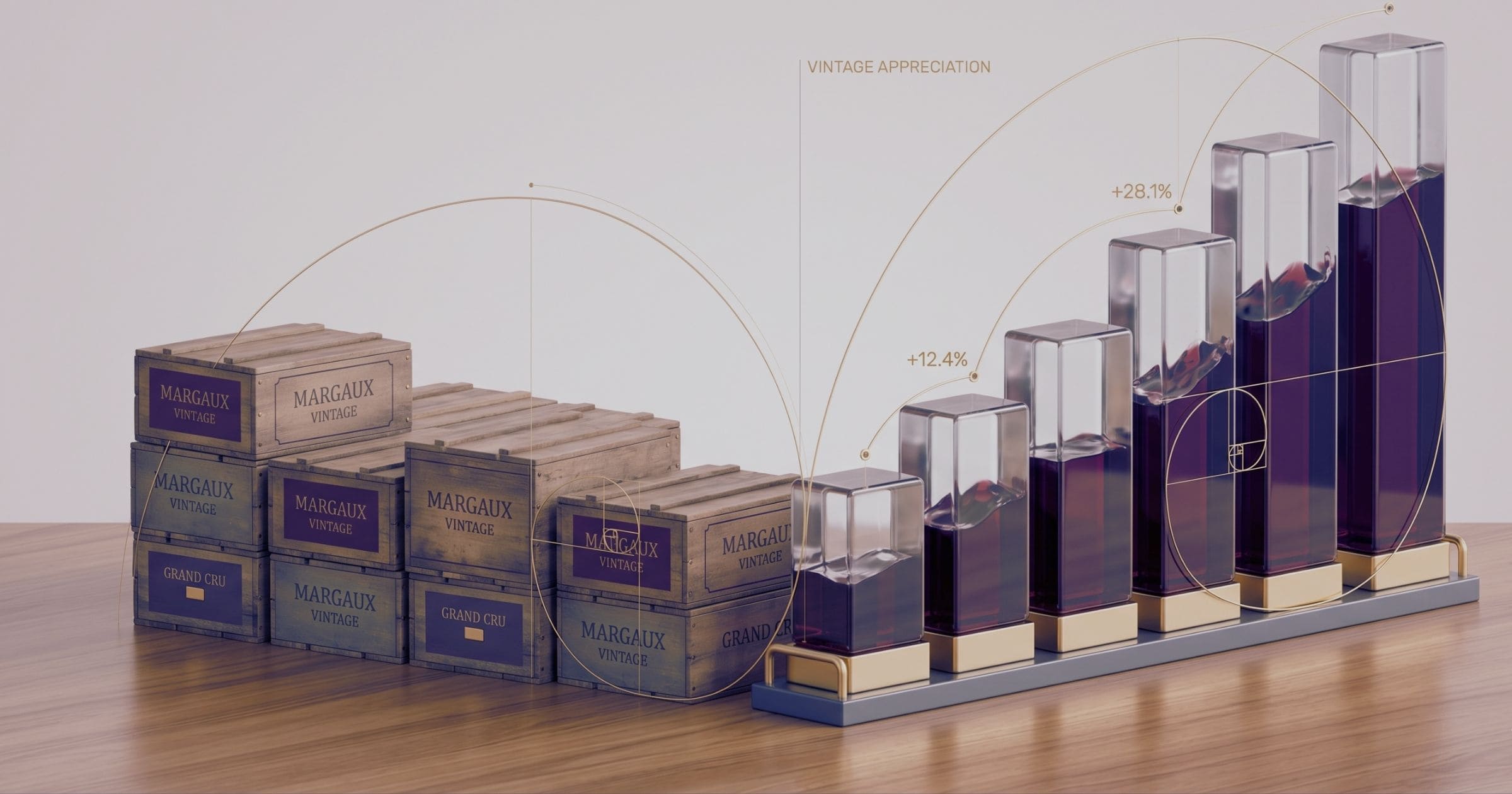
TL;DR
Quantitative wine investing applies data science and algorithmic models to identify underpriced wines with strong appreciation potential. By analysing vast datasets, quantitative frameworks replace subjective tasting notes with systematic selection. For example, the WineFi Investment Score (WIS) analyses roughly 100,000 wines, over 4038 variables, and more than one million critic reviews. It utilises dual machine-learning models to estimate efficient market prices and forecast returns, which has historically generated a 6.73% annualised alpha versus market benchmarks.
What is the difference between traditional and quantitative wine investing?
Traditional wine investment has historically relied on narrative, subjective relationships, and personal tasting preferences to select assets. Quantitative wine investing treats fine wine strictly as a financial asset, relying on vast datasets, systematic rules, and mathematical models to strip out human bias and identify mispriced opportunities.
For decades, the fine wine market operated largely on insider knowledge and informal networks. The introduction of standardised scoring systems, most notably the 100-point scale pioneered by Robert Parker, began the transition toward a more transparent market in the 1980s and 1990s. This standardisation allowed buyers globally to trade wines based on a legible signal of quality, leading to increased financialisation and the creation of secondary market indices.
Quantitative investing represents the next evolution of this process. Rather than relying on a single critic score or the prestige of a specific chateau, data-driven platforms process hundreds of thousands of data points simultaneously. This systematic approach allows investors to evaluate the entire global investable universe objectively, identifying pricing anomalies and structural trends that no human analyst could spot manually. The objective is to generate alpha relative to a defined benchmark, such as the Liv-ex indices, by systematically sourcing opportunities the broader market has mispriced.
What data variables do algorithmic wine models actually use?
WineFi’s advances quantitative models analyse more than 40 distinct variables per wine, which are optimally weighted through rigorous backtesting, to forecast investment performance with precision. These inputs go far beyond simple historical pricing to capture the fundamental drivers of a wine's secondary market value.
To build a reliable predictive model, data scientists aggregate information from multiple sources. A robust proprietary dataset, such as the one used by WineFi, tracks pricing and trade data for approximately 300,000 wines from all investment-grade wine producers. The variables inputted into these models include:
Price metrics and trend analysis: Short and long-term historical price movements, current market list prices, and bid-to-offer spreads.
Critic and qualitative data: Over one million individual critic reviews, tasting notes, and projected optimal drinking windows.
Brand and producer metrics: Brand power, historical track records of specific estates, and cultural relevance.
Market dynamics: Liquidity measures, global supply and demand imbalances, and transaction volumes.
Climatic and vintage factors: Vintage quality ratings and specific regional climatic conditions during the growing season.
Categorical attributes: Regional characteristics, appellation rules, and formal classification rankings like the 1855 Bordeaux Classification or Burgundy Grand Cru status.
Lifecycle stage: The current age of the wine relative to its historical ageing curve and peak maturity.
By feeding these varied data points into a single framework, the model can assess whether a wine's current market price accurately reflects its underlying fundamental value.
How does machine learning identify mispriced fine wine?
Machine learning algorithms excel at identifying complex, non-linear relationships and persistent price patterns across market cycles that traditional analysis misses. This technology allows quantitative models to understand highly categorical data and nuanced distinctions across different regions and price tiers.
In the fine wine market, variables do not interact in straight lines. For example, a 98-point score from a major critic will impact the price of a £500 bottle of Bordeaux very differently than it impacts a £5,000 bottle of Burgundy. Similarly, certain region and vintage combinations age and appreciate on entirely different curves than others. Our machine learning techniques are designed to capture these nuanced, non-linear realities.
The WineFi quantitative framework achieves this through two closely linked models that reinforce one another:
The Efficient Market Price Model: This model analyses current data to estimate an objective "efficient market price" for every individual wine in the database. By comparing this calculated fair value against actual live market prices, the model instantly highlights wines that are currently underpriced or overpriced.
The Returns Ranking Model: This secondary model looks forward. It forecasts which specific wines are mathematically most and least likely to appreciate over a target holding period, typically the next four years.
When combined, these two models form the foundation of the WineFi Investment Score (WIS). The system specifically targets assets that are both undervalued today and demonstrate strong future appreciation potential, providing a repeatable mechanism for asset selection.
Does data replace human expertise in fine wine selection?
Quantitative models do not replace human expertise, they scale it. While algorithms process the data and highlight opportunities, an expert investment committee is required to provide qualitative oversight and final approval before capital is deployed.
A purely algorithmic approach carries risks in a market as fragmented as fine wine. Models rely on historical data and current market inputs, but they cannot always account for sudden qualitative shifts, unquantifiable provenance issues, or sudden changes in a specific producer's management structure for example.
This is why a "human-in-the-loop" approach is critical. At platforms like WineFi, wines that pass the rigorous quantitative filters are subsequently reviewed by a veteran investment committee.
This team evaluates the algorithmic recommendations and may accept or reject wines based on subtle qualitative factors that the models alone cannot capture. The data serves to systematically surface the best mathematical opportunities, while human judgement provides a final layer of risk management and practical market intelligence.
What is the exact process of a data-driven wine investment?
The quantitative investment process is a structured, multi-step sequence designed to filter hundreds of thousands of potential assets down to a strictly curated final portfolio. This process moves from broad data aggregation to precise market execution.
The systematic methodology typically follows these six distinct stages:
Define Scope: The process begins with a global universe of roughly 300,000 wines. Structured quantitative filters are applied based on region, pricing parameters, and liquidity characteristics to eliminate wines that are not practically investable, creating a targeted subset.
Apply the Algorithmic Score: Each wine remaining in scope is assigned a numeric score on a scale of 0 to 100, such as the WineFi Investment Score (WIS). This score ranks wines consistently across regions and vintages based on their potential to outperform average returns over the coming investment period.
Human Review: The highest-scoring wines are presented to an expert investment committee. The committee reviews the data and applies qualitative scrutiny, accepting or rejecting specific wines based on real-world market factors.
Investor Approval: Once a final collection of target wines is identified, the opportunity is structured and presented to investors. This can be executed on a discretionary basis for private portfolios or a non-discretionary basis for syndicates.
Sourcing and Execution: The acquisition team goes to the secondary market to acquire the approved wines, strictly aiming to transact at or below the target prices dictated by the model. The acquired wines are then transferred into secure bonded storage.
Monitoring and Exits: The models do not stop working after purchase. They continuously monitor live market conditions and individual wine performance. Exit recommendations are generated dynamically based on the data, and clients can accept or decline these recommendations when the optimal selling window is reached.
For more information, read our piece on how to start investing in fine wine.
Can quantitative models predict future wine prices?
Quantitative models cannot guarantee future prices, but historical backtesting proves they can reliably identify statistical probabilities and consistently outperform benchmark indices. The goal is to stack the mathematical odds of appreciation in the investor's favour. Finding this with larger portfolio sizes achieved through co-investment or syndicates, allows one of our investors to capture this average model-driven alpha.
No financial model can predict the future with absolute certainty. The fine wine market is subject to macroeconomic shifts, global liquidity changes, and unforeseen geopolitical events that influence aggregate pricing. However, backtesting models against historical market data provides a clear view of their efficacy.
When the WineFi Investment Score models were tested against historical market data from 2009 to 2025, the algorithmic approach was shown to outperform benchmark average returns by 6.73% annualised.
This means that systematically applying data-driven selection criteria materially improved outcomes compared to holding a passive index of investment-grade wine. While past performance is not a reliable indicator of future results, this data demonstrates that a quantitative framework provides a highly scalable and repeatable method for outperforming market averages.
How quantitative wine investing connects to your portfolio
Understanding the quantitative mechanics behind fine wine highlights why it functions as a credible alternative asset rather than a passion project. By applying rigorous data science to asset selection, investors can access a market driven by structural scarcity and global consumption, without relying on guesswork.
The process of buying mispriced, high-quality assets and holding them through an optimal value-creation window is fundamentally similar to disciplined property investment. It requires a medium-to-long-term holding period, usually 4 to 7 years, to allow the investment thesis to play out.
To explore the data further and understand the structural drivers of the market, read our 2026 Fine Wine Investment Guide. If you are ready to allocate capital using a systematically tested approach, sign up to view our current investment opportunities.
Frequently asked questions
What does "alpha" mean in fine wine investing?
Alpha refers to the excess return generated by an investment portfolio over a designated market benchmark. In fine wine, if the broader Liv-ex 1000 index returns 5% in a given year, and a quantitative portfolio returns 10%, the alpha generated through asset selection is 5%. WineFi models aim to generate positive alpha systematically. Another benchmark we use internally is the mean performance of all qualifying investment-grade wines — wines produced by investment-grade producers with proven secondary market liquidity, above a minimum price threshold and at investment age. This provides a second internal benchmark by which to measure alpha: how does our model perform versus picking investment-grade wines at random?
Do I need to understand data science to invest quantitatively?
No. The complex machine learning algorithms and data aggregation are handled entirely by the platform's infrastructure and investment team. Investors benefit from the outputs of the models through curated private portfolios or syndicate opportunities, without needing to process the underlying mathematics themselves.
Are all fine wines suitable for algorithmic analysis?
No. Quantitative models require robust, historical data sets to function accurately. Therefore, they are most effective when applied to the core investment-grade universe of wines that have clear secondary market trading histories, more efficient pricing, sufficient liquidity and for backtesting are of investment age.
How frequently do quantitative models update?
Advanced algorithmic models continuously process new market inputs. As fresh trades occur on secondary platforms, new critic reviews are published, and broader market liquidity shifts, the models ingest this data to update their efficient market price estimates and adjust forward-looking return rankings dynamically. Our models infer on a daily basis, and are retrained periodically.
Can a machine factor in a wine's provenance?
Models process verifiable data, such as a requirement for continuous bonded storage. However, physical condition checks, label integrity, and complex chain-of-custody verifications still require human intervention. This is why human review and strict sourcing protocols remain a mandatory step in the quantitative investment process.
What happens if the algorithmic model gets it wrong?
Like any investment strategy, quantitative selection carries risk. An individual wine may fail to appreciate as forecast due to shifting consumer tastes or broader market corrections. This risk is mitigated through strict portfolio construction and diversification, ensuring that capital is not overly concentrated in a single asset or region based on one prediction.
This article is provided for general information and is not personal tax or investment advice. Capital is at risk. Wine values can go down as well as up, and investments may not perform as expected. Returns may vary. You should not invest more than you can afford to lose. WineFi is not authorised by the Financial Conduct Authority. Investments are not regulated and you will have no access to the Financial Services Compensation Scheme (FSCS) or the Financial Ombudsman Service (FOS). Past performance and forecasts are not reliable indicators of future results. Investments are illiquid. Tax treatment depends on individual circumstances and may change. You are advised to obtain appropriate tax or investment advice where necessary. WineFi is a trading name of WineFi Management Limited.




Capital is at risk. Wine values can go down as well as up, and investments may not perform as expected. Returns may vary. You should not invest more than you can afford to lose. WineFi is not authorised by the Financial Conduct Authority. Investments are not regulated and you will have no access to the Financial Services Compensation Scheme (FSCS) or the Financial Ombudsman Service (FOS). Past performance and forecasts are not reliable indicators of future results and should not be relied on. Forecasts are based on WineFi’s own internal calculations and opinions and may change. Investments are illiquid. Once invested, you are committed for the full term. Tax treatment depends on individual circumstances and may change.
You are advised to obtain appropriate tax or investment advice where necessary.
WineFi is a trading name of WineFi Management Limited. Registered in England and Wales with registration number: 14864655 and whose registered office is at 5th Floor, 167-169 Great Portland Street, London, United Kingdom, W1W 5PF.