



Michael Burry's most recent piece has exploded fine wine investment into the public consciousness.
WineFi is the UK's leading fine wine investment company, and the only one with proprietary, alpha generating AI/ML backed fine wine valuation and asset selection models. Through building those models we have learned a thing or two about how this market actually behaves.
Burry is a controversial figure and, although famous for being extremely right, has also been publicly wrong more than once. So it is worth being careful about which parts of this are signal and which are noise.
Everyone already knows the basics: custody, provenance, insurance, buying in bond, buying the biggest names with proven liquidity, scarcity, price performance and brand power, avoiding high fees on entry and exit, cost of carry etc. Those are all non-negotiables.
So what has Burry actually added to the debate?
The core
Burry's claim is that just about every case sitting in a London bonded warehouse can be "a short position on the U.S. dollar, a global hedge against fiat currency", and a ward against whatever AI and quantum computing do to financial systems.
The argument rests on main points:
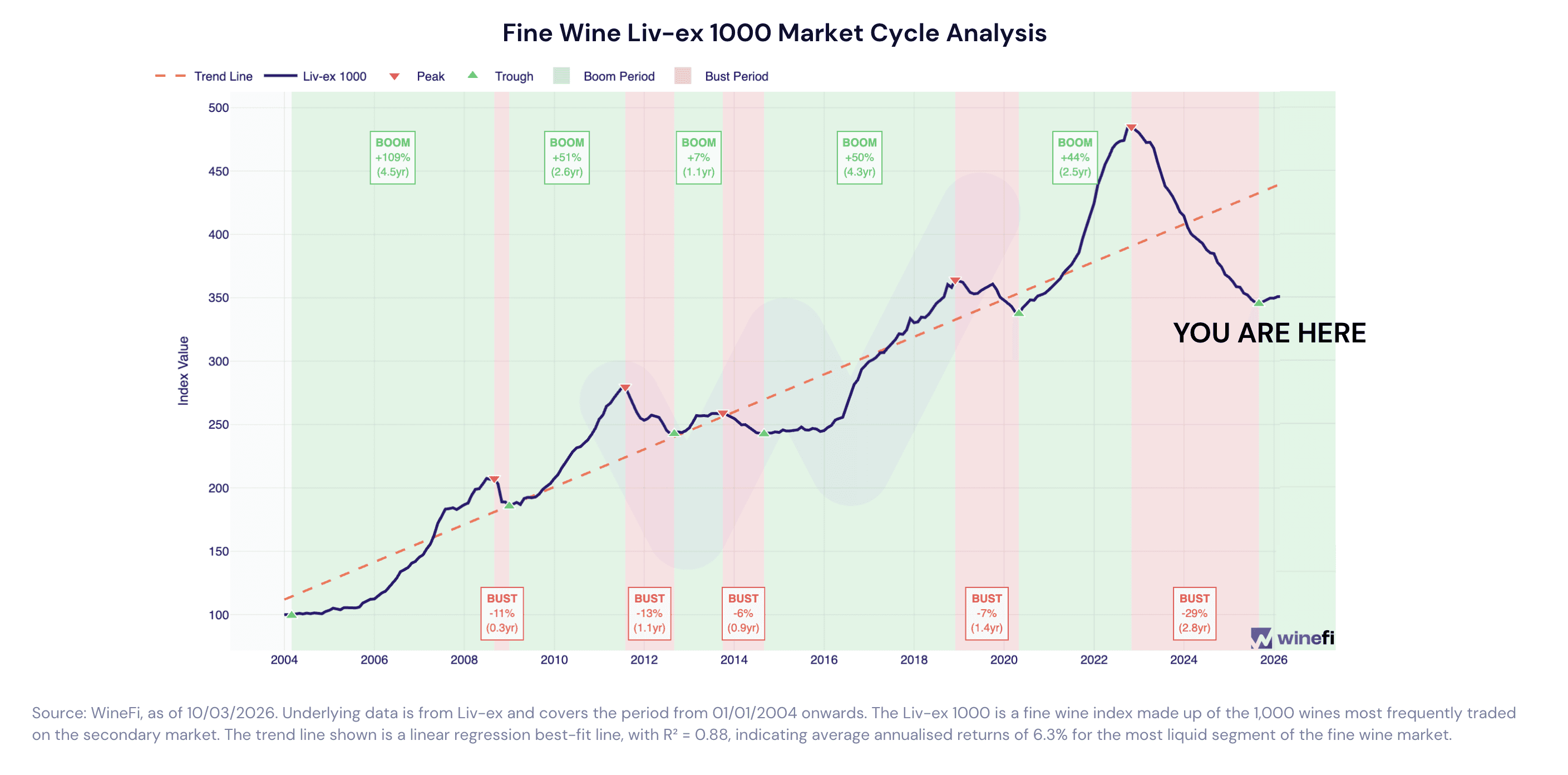
Buy the dip. Fine wine prices are down 25-30% from the October 2022 highs, which Burry reads as a correction in a physical asset that is inherently limited in supply. You can't make more Margaux 2015.
The Liv-ex Fine Wine 100 is negatively correlated to the dollar, at least over long holding periods.
Fine wine shows essentially no correlation to the S&P 500 over 25 years.
Underneath all three sits his macro case: As fiat currencies face long-term inflationary pressure and governements like the US pile on debt via unsustainable deficits, physical hard assets provide stability.
“The dollar’s share of allocated foreign reserves has declined from 72% in 2001 to slightly less than 57% as of the third fiscal quarter of 2025. The lowest since 1995… there has been less central bank shifting among currencies and more central bank investment in gold.”
The US Treasury has itself described its fiscal path as long-term unsustainable. Burry's framing is that the dollar does not lose reserve status tomorrow, but that over five to ten years he sees "a colossal train wreck as the bills of fiscal irresponsibility come due".
The logic of the wine leg is: Wine held in bond in Europe is priced by a global, multi-currency bid: sterling, euros, francs and Asian currencies. If the dollar weakens 30-40% against that bid over two decades, then even "a flat wine market still delivers +45-65% in dollar terms", before any real return from the wine itself. And flat is unlikely, because the asset ages into its drinking window while the float is continuously destroyed by consumption.
The good - what Burry gets right
Market timing.
Burry is right that 2026 **is not a random entry point, but "an entry point timed to a depressed market". Fine wine has been in a near three-year bear market, with prices "tumbled roughly 25-30% on the Liv-ex indices" from the October 2022 peak. That is the deepest broad drawdown of the modern index era.
This is true, and it is one of the great ironies of investing that corrections like this are also the hardest time to convince new entrants to invest. But the smart money buys the dip and sells close to the top.
Fine wine as a diversification play.
Fine wine is driven by a distinct set of economic, agricultural and cultural forces. Its pricing is grounded in scarcity, vintage quality, producer reputation and the preferences of a global collector/drinker base, dynamics that have little to do with interest rate cycles or corporate earnings. That makes it a genuinely good candidate for a diversifier.
Burry is very bullish here, concluding that the assets are so persistently uncorrelated that "bonded fine wine is a near-perfect diversifier". His evidence is that "monthly returns show a 0.136 positive correlation with p=.02" against the S&P 500 over the last quarter century, with the rolling five-year correlation hitting a record low in August 2025.
Our own reporting has consistently found the same direction of travel: low, time-varying correlation, meaningfully lower than equity-to-equity or credit-to-equity pairs.
We would put it slightly differently, though. "Low and inconsistent" correlation is closer to the truth whilst nodding to the inherent difficulties of comparing a frequently traded index tracker (S&P 500) with a low liquidity physical asset like fine wine.
For more information, you can read a great paper by our investment committee member and assistant professor at the University of Auckland, Gertjan Verdickt.
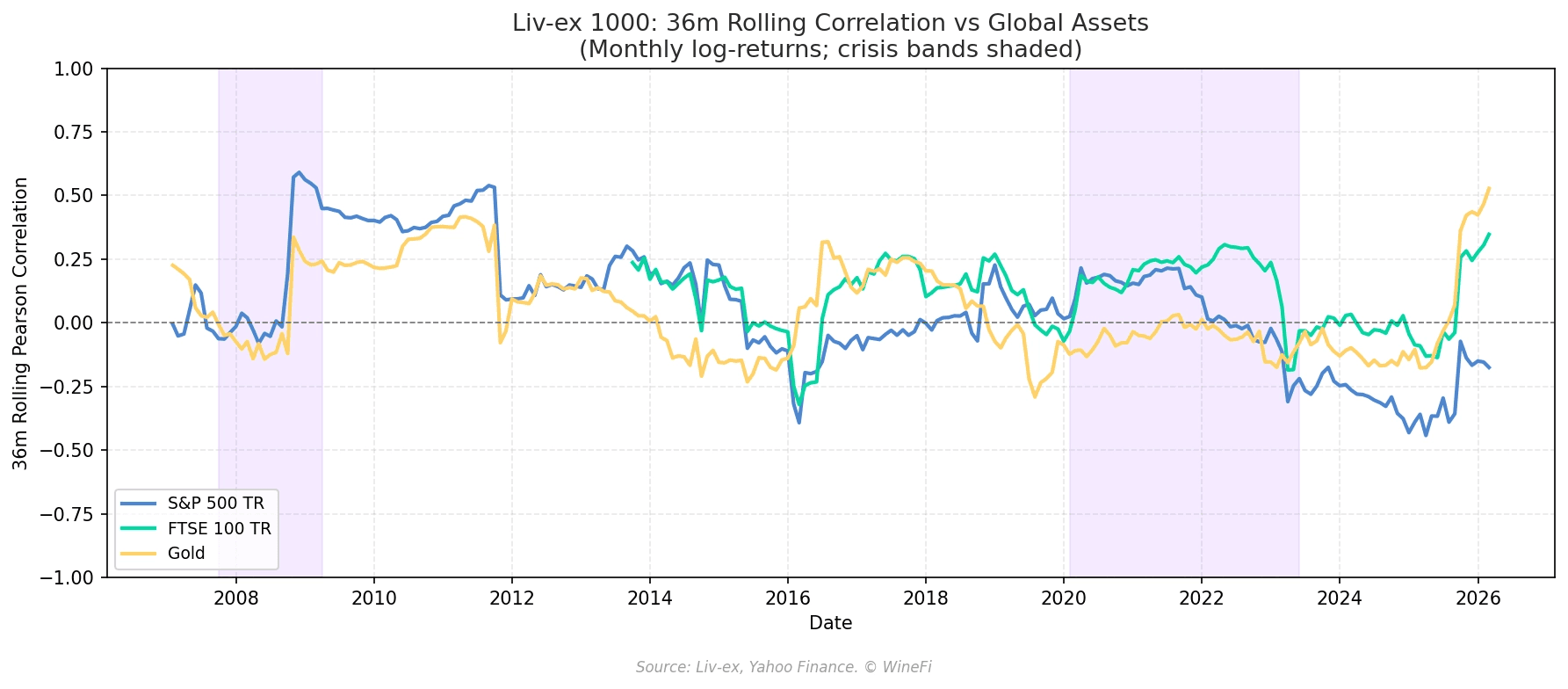
36-month rolling correlation of Liv-ex 1000 vs S&P 500, FTSE 100, and Gold. Uses Liv-ex 1000 as the reference index (broader than the Liv-ex 100). Highlighted periods, global financial crisis, and COVID.
Fine wine's correlation with equities is low over most of the period covered, but it is not zero and it is not stable. There are periods - notably around the 2008 financial crisis - when correlation rises, peaking briefly above 0.5 on a three-year rolling basis (where 1.0 means assets move in perfect lockstep and 0 means they move entirely independently). Adjusting for currency, though, drawdowns were significantly less even in this one short period of higher correlation, see below.
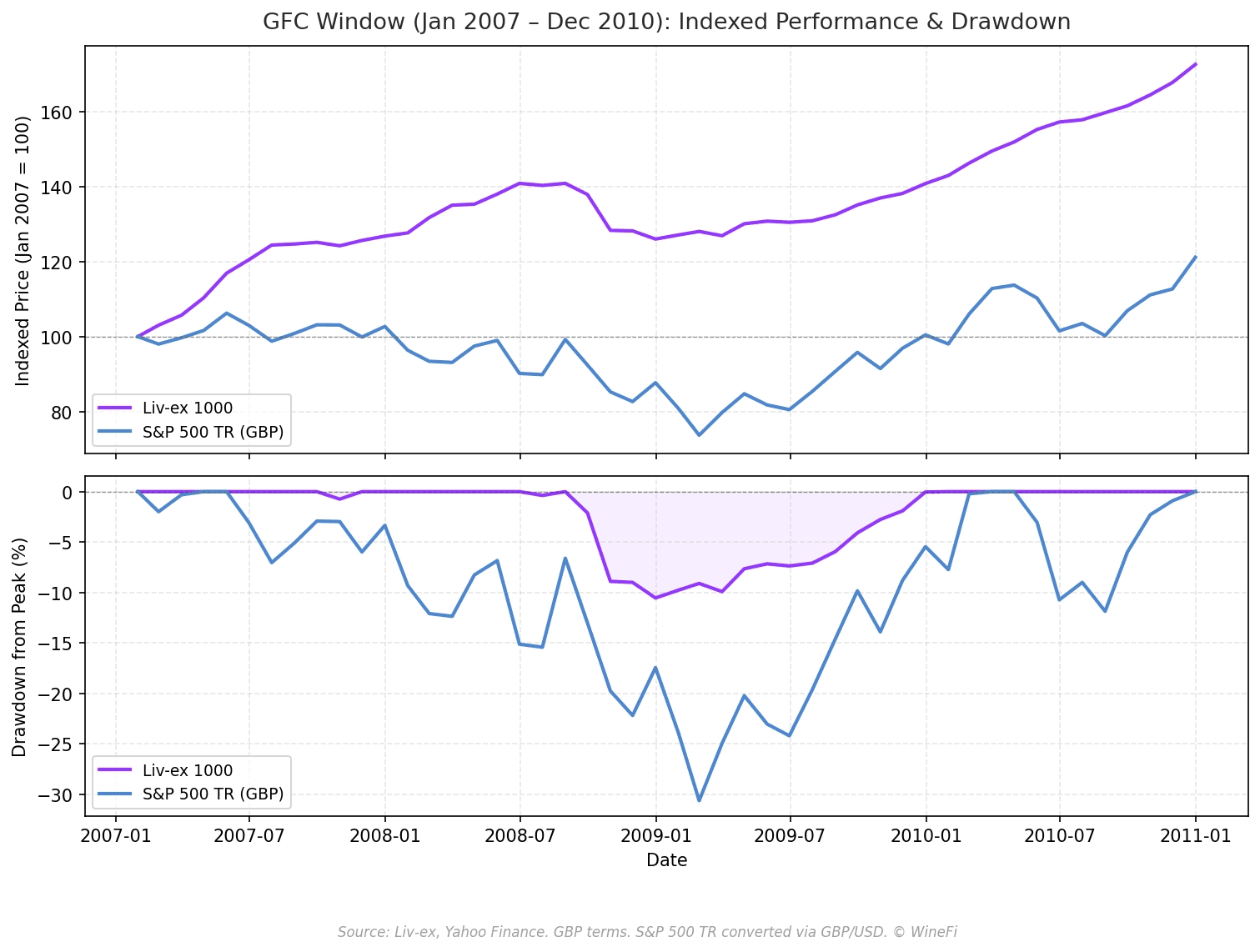
This is not simply an index construction artefact. The period captured active trading at market prices. The divergence in drawdown depth and recovery speed reflects a genuine difference in the economic forces acting on each asset class.
Fine wine's relationship is meaningfully different from conventional asset pairs. Rolling correlations between major equity markets (S&P 500, Nikkei 225, Hang Seng) frequently range from 0.4 to 0.6 and spike above 0.7 during crises, while corporate bond–equity correlations (particularly high-yield) typically exceed 0.5.
In an increasingly interconnected financial system, where gold-equity and bond-equity correlations have both spiked, fine wine has a strong argument as a diversifier in a balanced portfolio. It is not a perfect hedge and should of course be treated with caution. Fine wine is not fully insulated from financial conditions. The wealth effect, money supply, exchange rates and global risk appetite all exert real influence on demand.
But for investors seeking assets that behave differently from equities and bonds across a full cycle, a carefully selected fine wine portfolio can play a meaningful structural role. Selection is what makes that sentence true.
And Burry, strangely, builds his case however on the most macro-sensitive part of the fine wine market, which we come back to below.
Selection, selection, selection (of assets and entry prices).
On buying discipline Burry is completely right, and refreshingly blunt about it: of around 700 wines he considered this year, he bought about 40. You say the buying's easy, it's the selling that's the hard part. The reality is, if you buy the right things at the right prices, the selling can be easy too.
This is WineFi's founding thesis. Only 20 to 30% of investment-grade wines appreciate in any given quarter. Selection and entry price determine the outcome, not just asset class exposure.
TruePrice, our proprietary trade-based valuation model, and;
The WineFi Investment Score (WIS), our machine learning driven asset selection model,
exist precisely to solve that problem systematically and repeatably.
Entry discipline and asset selection are the only game. Data is the edge.
Burry says, “Ideally one would have multiple dealers so as to cross-check prices.” That’s why we built our TruePrice model, we do that work for you.
Across 816,832 wine-vintage-bottle combinations we price, the majority of the time the cheapest offer price on the market sits well above actual trading values. The less liquid a wine is the worse this issue is. The median lowest listing sits 20.8% above TruePrice:
72% of listings sit above TruePrice
29% are more than 50% above TruePrice
13% are listed at more than double TruePrice
And 17% are more than 10% below (it does cut both ways)
Same pattern by region (median):
Champagne +8.7%
Bordeaux +8.9%
Piedmont +12.7%
Burgundy +21.6%
Burry’s guide of aiming for 18-20% below market is broadly right. And thats what we achieve for our clients, consistently.
Don't buy fine wine on release.
Burry notes that from the GFC onward Lafite has priced its product to capture future appreciation itself, and that Liv-ex's own data show "many vintages released since 2010 still trade below release".
Producers price new vintages to maximise their own profit. Not to match secondary market trading levels on back vintages, and certainly not to leave you room for market-beating returns. Sorry to ruin the romance, but a producer setting a release price is asking one question: what price gives us maximum profit? They have a myriad of ways to influence distributors, merchants and even critics in service of that answer.
The bad - what Burry gets wrong
Burry is overly focused on Bordeaux, in spite of hinting at several of the anti-Bordeaux arguments himself.
He writes that every bottle consumed anywhere on earth "shrinks the inventory of that exact asset forever". True, but that factor matters more the more restricted the supply. And as he concedes, "supply is industrial scale for some of these First Growths now".
In fact it is industrial scale for all of them. They each produce well over 100,000 bottles a year. Burry's own comparison is that Lafite alone makes roughly triple what all seven of DRC's grand crus produce between them. Add the simple fact that Bordeaux is fairly out-of-fashion, and the case for Bordeaux is weaker than the case for the high liquidity Burgundies, prestige Champagnes and Italian legends.
Yet his argument rests on the Liv-ex 100 and the Bordeaux 500, and the recommended universe is first growths, DRC and top Super Tuscans. Our research concludes close to the opposite: Bordeaux-weighted indices are the most financialised and least diversifying segment of fine wine. The stronger correlation profile sits in scarcer Burgundy, prestige Champagne and reputation-driven producers with collector bases less sensitive to financial sentiment. Think Salon, Krug, Leroy, Arnoux-Lachaux, Soldera, Rousseau, Selosse, Rayas.
Burry advises buying only very high scoring wines. Ceteris paribus this looks sensible. In practice the case for 98+ point wines has been damaged badly by historic performance data.
This is a classic case of “buy the rumour, sell the news”. Everyone and their dog advises buying high scoring and 100-point so called "perfect" wines. What does that do? It pumps up the prices of those exact vintages, and it gives producers cover to release at extortionate prices, eating into future appreciation before the investor has bought anything.
What we find, time and again, is that relative value is more effective. The fact that you are buying Salon, DRC, Pétrus, Figeac, Le Pin, Sassicaia or Krug matters more than the fact that you are buying a 100-pointer. Buyers vote with their money, and over the last 20 years lower-scoring vintages have tended to appreciate more across all of the major producers.
The counterargument is: the highest scoring vintages are the ones most likely to age exquisitely, and therefore to find consistent secondary market demand. But these days for the world's most famous producers, every vintage is now in demand and every vintage ages well.
Burry half concedes this point himself. With an example of a 96-97 point Pavie 2021, he notes he almost passed on it because of the "relatively low" score, before buying on the discount instead.
On the flip side, he notes an example of the exact issue we're talking about with the “Lafite Rothschild 2010. Parker rating 100… Fifteen years of holding a perfect-score First Growth Bordeaux returned less than nothing.” It was overpriced to begin with and bought at the top of a market.
Fine wine as a hedge against the dollar, AI and general financial armageddon.
Is really at the core of his argument, and it's the least proven point.
Burry's own monthly numbers show a -0.09 correlation between the Liv-ex 100 and the dollar index. The -0.74 correlation he discusses only appears in overlapping five-year windows, and 25 years of data holds about five independent five-year periods. Not enought data to really do anything with.
Overlapping windows will find you a pattern out of almost nothing. To his credit he tests this himself, and reports that noise alone produces that neat staircase 38% of the time. The up-years versus down-years split isn't particularly significant significant either and Burry says so, calling his method "more Boy Scout than Army Ranger"
There's always a limit to what you can do with data, especially macro data and especially in fine wine.
None of this kills his idea, if you hold dollars, owning a sterling and euro priced real asset is currency diversification, that part needs no statistics. It's the other part that's unproven put simply: wine rising because the dollar falls.




Capital is at risk. Wine values can go down as well as up, and investments may not perform as expected. Returns may vary. You should not invest more than you can afford to lose. WineFi is not authorised by the Financial Conduct Authority. Investments are not regulated and you will have no access to the Financial Services Compensation Scheme (FSCS) or the Financial Ombudsman Service (FOS). Past performance and forecasts are not reliable indicators of future results and should not be relied on. Forecasts are based on WineFi’s own internal calculations and opinions and may change. Investments are illiquid. Once invested, you are committed for the full term. Tax treatment depends on individual circumstances and may change.
You are advised to obtain appropriate tax or investment advice where necessary.
WineFi is a trading name of WineFi Management Limited. Registered in England and Wales with registration number: 14864655 and whose registered office is at 5th Floor, 167-169 Great Portland Street, London, United Kingdom, W1W 5PF.