



WineFi Data Team | Portfolio Construction & Strategy
Timing matters in any investment, and fine wine is no exception. Yet unlike equities or bonds, where entry timing is governed primarily by macroeconomic conditions, wine presents a unique additional dimension: the age of the wine itself. A bottle of Domaine de la Romanée-Conti at three years old occupies a fundamentally different position on its price lifecycle than the same wine at fifteen years old - and understanding where a wine sits on that curve is essential to making informed investment decisions.
Our data team has conducted a comprehensive market-adjusted lifecycle analysis across all major investment-grade wine regions, examining how prices evolve relative to their regional benchmarks from the point of market entry through to twenty-five years and beyond. The methodology tracks price evolution against the relevant Liv-ex regional index, isolating the age at which wines tend to outperform the broader market - and when they cease to do so.
Methodology
Our analysis applies the following filters: average prices of £720 or above per twelve-bottle case, vintages from 1980 onwards, and adequate current liquidity as a proxy for reliable market pricing. We construct equal-weighted indices that allow wines to enter at regionally appropriate ages while maintaining baseline comparisons, and we adjust for broader market movements by removing the benchmark regional index return for each period. Vintages are colour-coded by average critic score to capture the influence of vintage quality on price trajectory.
The optimal investment age for any individual wine is subject to considerably more forces than age alone. Drinking windows, brand ageing reputation, release pricing, prevailing market conditions, and the number of successive strong or weak vintages for a given region all exert influence. What follows are broad generalisations drawn from historical data - a useful lens, but not the only one.
Regional Entry and Exit Windows
Region | Wine Type | Optimal Entry Window | Optimal Exit Window |
|---|---|---|---|
Bordeaux | Red | 5-7 years | Before 21 years |
Burgundy | Red | 5-8 years | 24+ years |
Burgundy | White | 3-5 years | 20+ years |
California | Red | 8-10 years | 16+ years |
Champagne | Vintage Sparkling | 10-12 years | 20+ years |
Piedmont | Red | 6-9 years | Unpredictable after 20+ years |
Tuscany | Red | ~4 years | 22+ years |
Burgundy: The Clearest Pattern
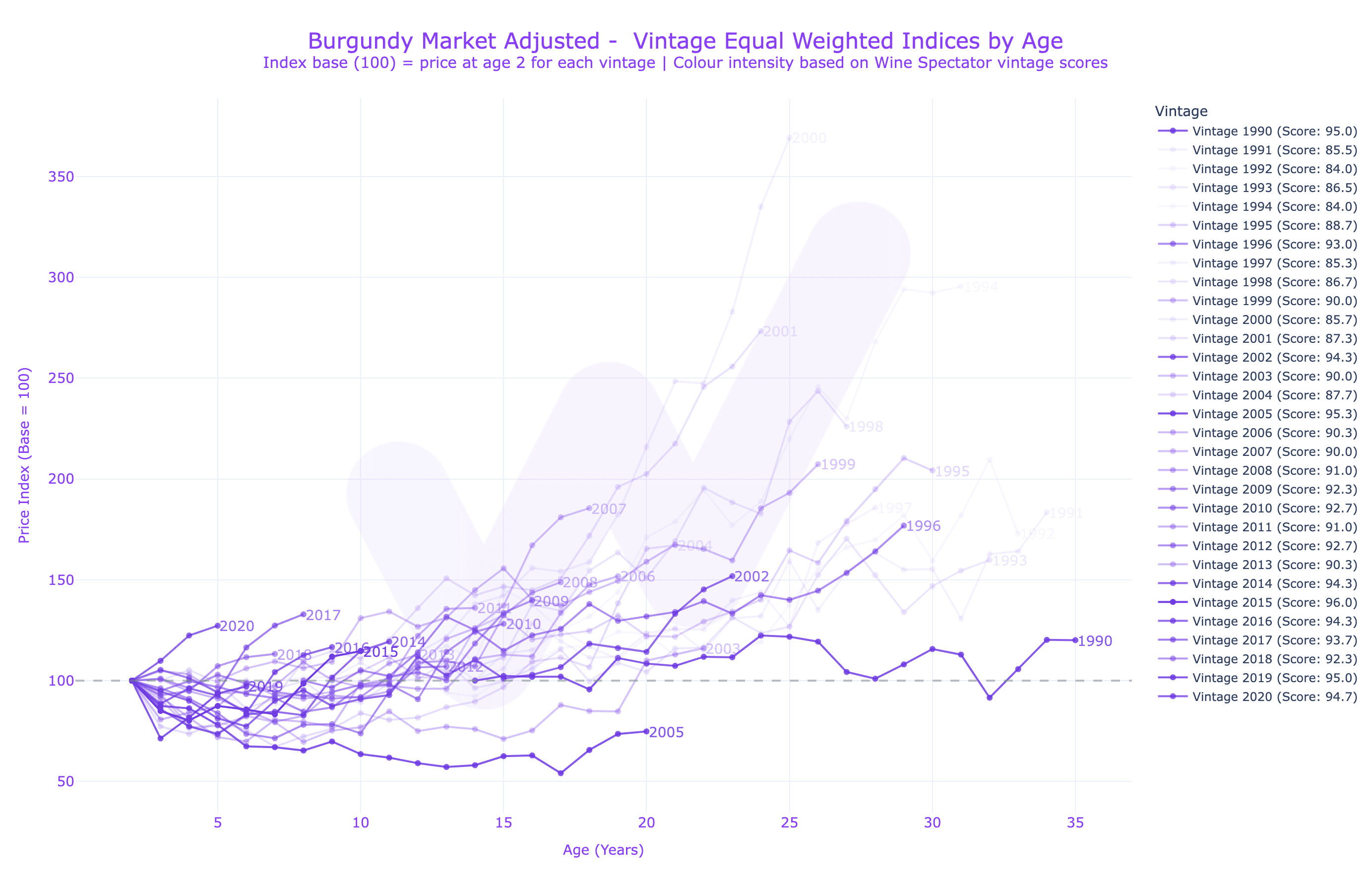
Burgundy provides the most instructive illustration of age-based price dynamics. Red Burgundies tend to underperform their regional benchmark during the first six years following vintage, with meaningful outperformance beginning at approximately seven to ten years of age and continuing consistently from that point onwards, plateauing around age twenty-five as the spread of returns widens significantly.
White Burgundies display a similar but compressed pattern: underperformance relative to the market until four or five years of age, followed by stronger appreciation from ages four to eleven. Beyond age twenty, returns diverge sharply as wines split into two distinct categories - those that have become true collectibles, and those that have passed their useful life.
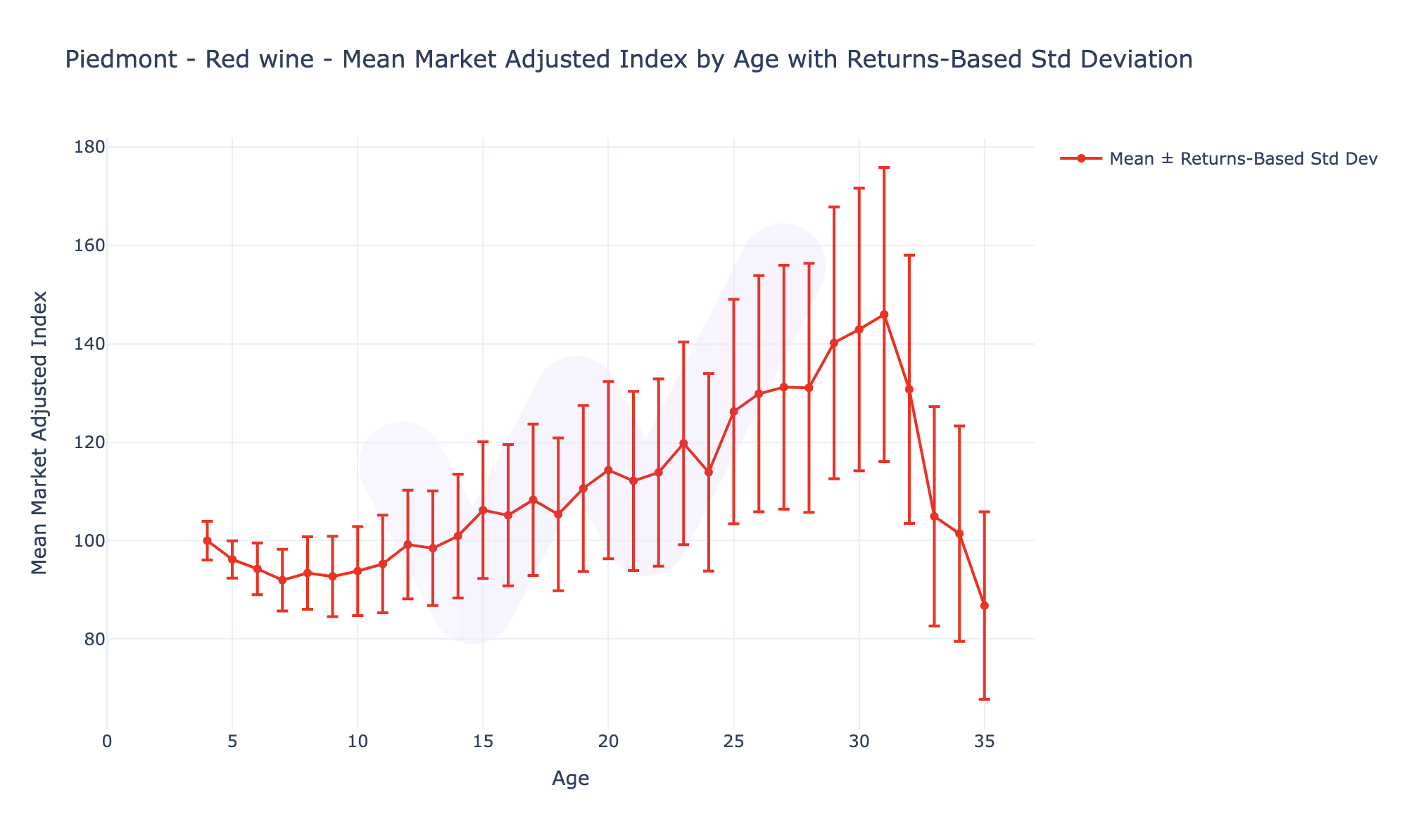
This widening of standard deviations with age is a consistent finding across all regions. As wines age, their cross-sectional returns become more volatile, less reliable, and less predictable. The implication for portfolio construction is clear: younger wines within their optimal window offer a more dependable risk-return profile than older wines, where outcomes become increasingly binary.
Bordeaux: Cyclicality and the En Primeur Effect
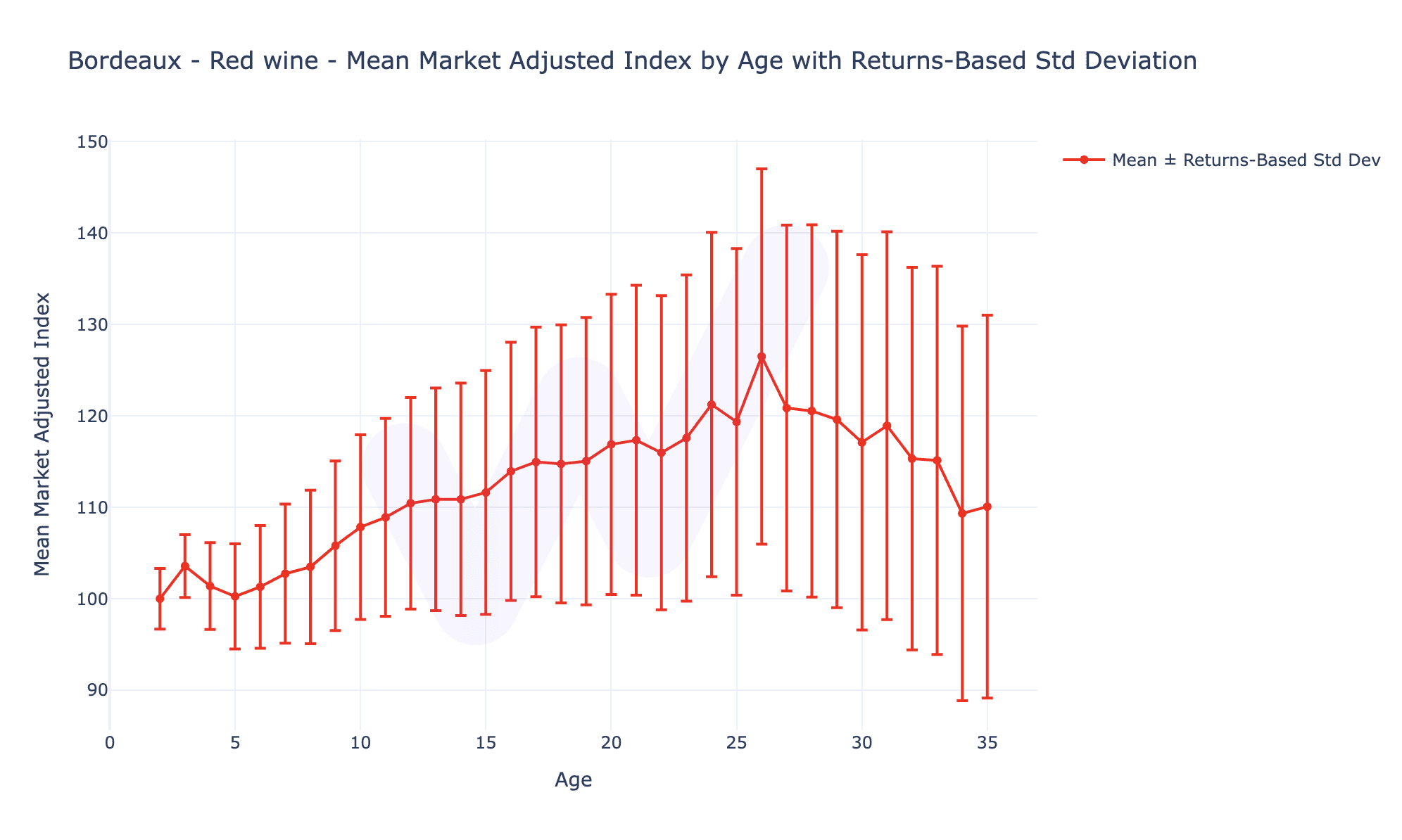
Bordeaux reds present a relatively tight alignment between investment windows and drinking windows. The optimal entry point falls at five to seven years of age, with returns tending to weaken beyond age twenty-one. Bordeaux has historically been the most cyclical of the major investment regions, a characteristic driven in part by the en primeur system's capacity to set market sentiment. The period from 2003 to 2011 delivered exceptional returns; subsequent performance has been more subdued.
Tuscany and Piedmont: Newer Investment Frontiers
Tuscan reds show an early optimal entry point - approximately four years of age - reflecting the region's relatively recent emergence as a serious investment-grade category. The lifecycle data here is somewhat skewed by the fact that older Tuscan vintages were produced before the region attracted significant investment attention, meaning their pricing data is sparser and less reflective of current market dynamics.
Piedmont follows a similar pattern, with an optimal entry window of six to nine years and returns that become unpredictable after age twenty. The alignment between investment windows and drinking windows is relatively close in both Italian regions.
Champagne: The Long Game
Vintage Champagne presents the longest entry window of any major region - ten to twelve years - reflecting the extended ageing process and later market release that characterises the category. The surprisingly long drinking windows (median start at ten years, median end at twenty-eight years) align well with the investment period, and the data suggests that well-selected vintage Champagne continues to appreciate meaningfully through to age twenty and beyond.
California: A Narrower Window
Californian reds display the narrowest window of outperformance relative to their drinking dates. The optimal entry point falls at eight to ten years, but the window of market outperformance closes at approximately sixteen years - considerably sooner than the median drinking window end of twenty-two years. This suggests that while Californian wines retain drinkability for an extended period, the price appreciation driven by investment demand dissipates earlier than in European regions.
Drinking Windows and Investment Windows
The relationship between drinking windows and investment windows is not always intuitive. Our analysis of median drinking windows - drawn from critic reviews across Jancis Robinson, Vinous, and Wine Advocate - reveals the following:
Region | Colour | Median Age at Drink Start | Median Age at Drink End |
|---|---|---|---|
Bordeaux | Red | 5 | 24 |
Burgundy | Red | 5 | 20 |
Burgundy | White | 4 | 15 |
California | Red | 4 | 22 |
Champagne (Vintage) | White | 10 | 28 |
Piedmont | Red | 6 | 23 |
Tuscany | Red | 5 | 20 |
In most regions, the investment window tracks the drinking window reasonably closely - wines appreciate while they are at their most desirable for consumption, with the scarcity of consumed bottles supporting prices. The notable exceptions are California (where the investment window is considerably shorter than the drinking window) and Burgundy (where reds and whites can be invested somewhat longer than their typical drinking period might suggest).
Implications for Portfolio Construction
The lifecycle data carries several practical implications for how we construct portfolios at WineFi. First, regional allocation should account for where each region's current vintages sit on their respective price curves. Second, entry timing should target the early portion of each region's optimal window, allowing maximum time for appreciation. Third, exit planning should be built into the investment thesis from inception, with particular attention to the point at which return variability increases.
Most importantly, age-based analysis is one of several inputs into our WineFi Investment Score. It informs, but does not determine, investment decisions - which must also account for current market pricing, relative value, liquidity, and the idiosyncratic characteristics of each producer and vintage.




Capital is at risk. Wine values can go down as well as up, and investments may not perform as expected. Returns may vary. You should not invest more than you can afford to lose. WineFi is not authorised by the Financial Conduct Authority. Investments are not regulated and you will have no access to the Financial Services Compensation Scheme (FSCS) or the Financial Ombudsman Service (FOS). Past performance and forecasts are not reliable indicators of future results and should not be relied on. Forecasts are based on WineFi’s own internal calculations and opinions and may change. Investments are illiquid. Once invested, you are committed for the full term. Tax treatment depends on individual circumstances and may change.
You are advised to obtain appropriate tax or investment advice where necessary.
WineFi is a trading name of WineFi Management Limited. Registered in England and Wales with registration number: 14864655 and whose registered office is at 5th Floor, 167-169 Great Portland Street, London, United Kingdom, W1W 5PF.