


TL;DR
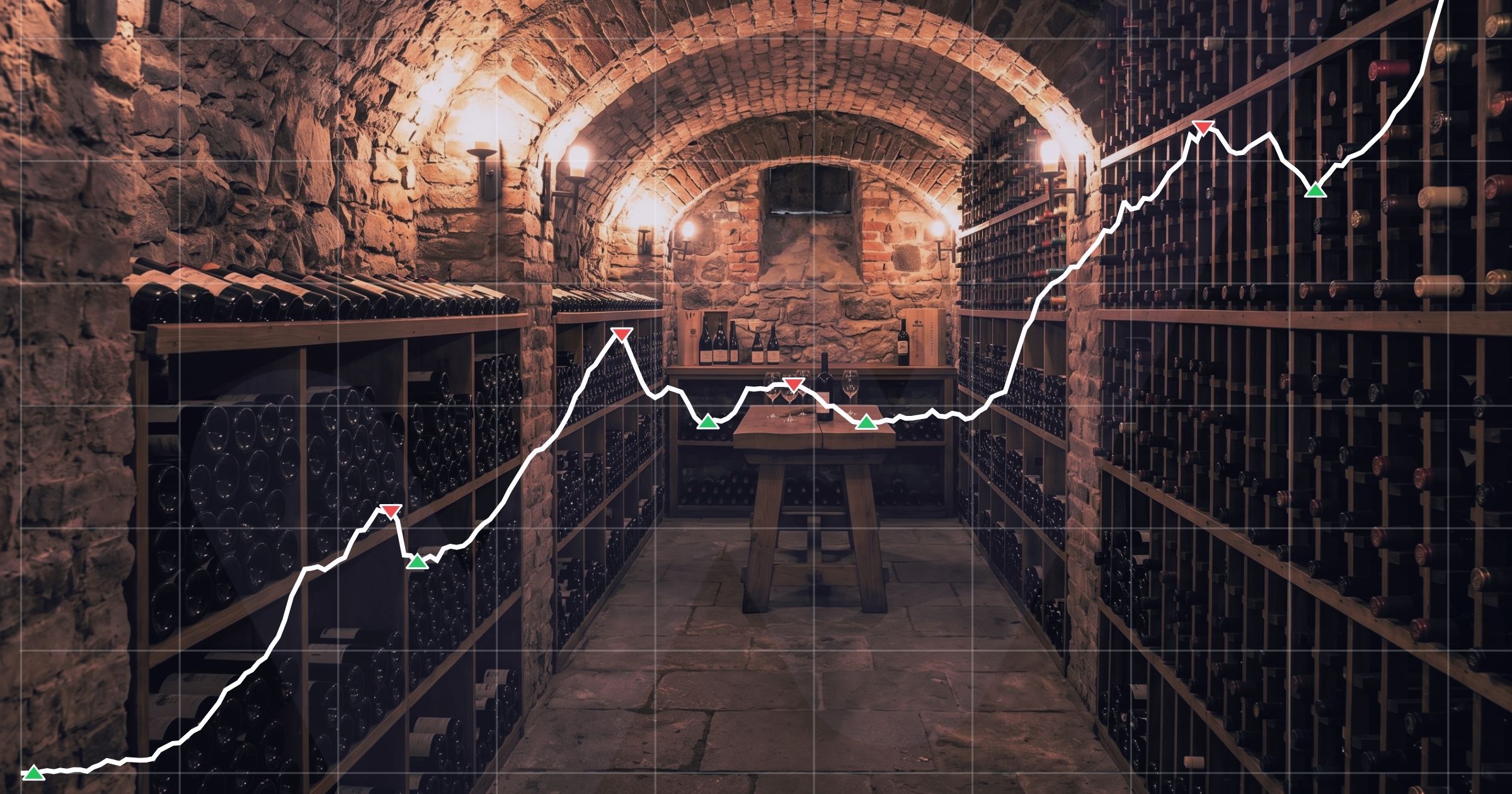
Understanding fine wine market cycles is essential for navigating this alternative asset class successfully, as prices move through distinct periods of expansion and consolidation. The market is highly cyclical, driven by shifts in global liquidity, macroeconomic changes, and regional buying behaviour rather than short-term financial noise. Over the long term, structural scarcity supports the asset class, but mid-cycle corrections can last several years. By analysing historic data from the Liv-ex 1000 index, investors can identify entry points and manage risk across shifting market regimes.
What drives a fine wine market cycle?
Fine wine market cycles are primarily driven by global wealth trends, currency fluctuations, regulatory shifts, and global interest rates rather than corporate earnings. While traditional financial instruments react instantly to daily news, fine wine adjustments happen more gradually and episodically. This creates extended periods where prices either climb steadily or undergo multi-year consolidations as the market adjusts.
At the foundation of every cycle is the interplay between growing global demand and completely rigid supply constraints. Because top-tier wines are protected by strict geographic and regulatory frameworks, such as the French appellation d'origine contrôlée (AOC) or Italian DOCG systems, production volumes cannot expand to meet rising interest. A vineyard in Burgundy or a First Growth estate in Bordeaux cannot simply plant more vines or manufacture extra cases when international buyers enter the market.
This structural scarcity tightens over time because bottles are regularly consumed, damaged, or opened, permanently reducing the remaining stock of a specific vintage. When global wealth expands, a rising number of collectors compete for a shrinking pool of physical assets. However, macro factors dictate the pace of this competition. For example, a weakening British Pound can make UK-bonded stock significantly cheaper for international buyers. Conversely, periods of tightening monetary policy or rising interest rates increase the opportunity cost of holding non-yielding real assets and reduces propensity to consume, causing buyers to become highly selective and slowing the velocity of trades.
What are the historic phases of fine wine market cycles?
The modern secondary market for fine wine has transitioned through several distinct cycles over the last quarter-century, moving from localised trading to a financialised global arena. Data from independent benchmarks highlights how periods of rapid appreciation are followed by necessary digestion phases, which realign asset prices with genuine consumer and collector demand.
2001 to 2008: Globalisation and financialisation
The inception of modern trading occurred as the market expanded beyond traditional European boundaries. The introduction of electronic trading platforms, most notably the London International Vintners Exchange (Liv-ex), brought transparency and trade-based pricing benchmarks to the category. For the first time, international participants could monitor live bid-and-ask data, transforming fine wine into a recognisable, tradeable alternative asset class.
2009 to 2011: The China-driven bubble
Following the global financial crisis, substantial fiscal stimulus in Asia fuelled an unprecedented wave of buying. Fine wine, particularly top-tier Bordeaux, became a premier vehicle for corporate gifting and status display. This concentrated demand caused prices to rocket toward historic highs, recording aggregate gains of up to 345%. The bubble peaked in the spring of 2011, eventually bursting that summer when the en primeur campaign for the 2010 vintage was priced too high, alienating the core market.
2011 to 2016: Stagnation and the Brexit realignment
Following the correction, the market entered a five-year period of flat or declining prices. This stagnation deepened when the Chinese government implemented a strict anti-extravagance campaign, which banned officials from accepting luxury items as gifts. The market structural floor was tested until June 2016, when the UK Brexit referendum caused the British Pound to drop overnight. Because the global fine wine trade is centred in London bonds, this currency adjustment made UK stock highly attractive to US and Asian buyers, triggering a multi-year recovery.
2019 to 2020: Tariffs and regional divergence
A geopolitical shift disrupted the market when the United States imposed a 25% tariff on French and Spanish wines under 14% ABV. This regulatory barrier forced a dramatic shift in buying patterns. Demand migrated away from newly penalised Bordeaux estates and flowed into tariff-exempt regions, driving rapid price gains for prestige Champagne houses and Super Tuscans.
2020 to 2022: The pandemic boom
The arrival of the pandemic created a unique confluence of supportive factors. Global central banks slashed interest rates to historic lows, while institutional and private investors found themselves with excess discretionary capital due to worldwide lockdowns. Simultaneously, digital trading platforms experienced rapid adoption. This surge of capital forced prices upward across all regions, peaking in October 2022. At its height, the Liv-ex Burgundy 150 index was outperforming the tech-heavy NASDAQ index by a margin of 30%.
2023 to Present: Correction and early-stage recovery
As central banks aggressively raised interest rates to combat inflation, the macroeconomic environment shifted. Higher yields on cash and short-term debt reduced the appetite for tangible assets that produce no regular income stream. Rather than forced selling, the market experienced an immediate slowdown in buyer activity. Liquidity contracted, bid-to-offer ratios dropped, and the most speculative portions of the market corrected by roughly 30% from their all-time highs. By late 2025 and early 2026, data confirmed that this correction had run its course, with the market establishing a stable floor and entering a fundamental-led recovery phase.
How long do fine wine boom and bust periods typically last?
Long-term market data reveals that fine wine expansions are typically multi-year trends, while corrections tend to be shorter, grinding periods of consolidation. Historically, expansion phases have lasted anywhere from three to five years, driven by capital inflows and systemic scarcity. In contrast, downturns often persist for eighteen to thirty-six months as excess pricing is digested.
Fine Wine Market Cycle Durations (Historic Liv-ex 1000 Analysis)
Cycle Phase | Historical Duration | Key Price Action Driver |
|---|---|---|
Post-GFC Expansion | ~2.0 Years (2009-2011) | Asian Market Entry |
Post-Bubble Digestion | ~5.0 Years (2011-2016) | Regulatory Gifting Bans |
Post-Brexit Recovery | ~2.5 Years (2016-2018) | Currency Devaluation (GBP) |
Pandemic Expansion | ~2.5 Years (2020-2022) | Low Rates & Excess Capital |
Macroeconomic Correction | ~2.8 Years (2023-2025) | Rising Global Interest Rates |
The duration of these cycles highlights the necessity of matching your time horizon to the natural mechanics of the asset class. Because fine wine is priced through discrete transactions rather than constant electronic updates, market adjustments take time to manifest completely. Short-term trading inside a two-year window exposes an investor to the risk of selling during a temporary consolidation phase, where transactional friction can erode nominal gains.
How do regional variations affect fine wine cycles?
The broad market index frequently masks significant divergence between individual producing regions. Fine wine is not a single monolith; different regions possess distinct supply characteristics, brand equity dynamics, and buyer bases, causing them to move on slightly different schedules during a market cycle.
Regional Market Characteristics & Cycle Dynamics
Region Profile | Market Share (Est.) | Price Volatility | Primary Liquidity |
|---|---|---|---|
Bordeaux | ~40% | Lower / Stable | Deepest secondary volume |
Burgundy | Highly Variable | Higher | Scarcity-driven spikes |
Champagne | Emerging Core | Moderate | Broad global consumer base |
Tuscany | Core Alternative | Low / Consistent | Steady institutional demand |
Bordeaux: The market stabiliser
Accounting for approximately 40% of secondary market trading volume, Bordeaux acts as the foundational core of the asset class. Because production volumes are relatively high compared to boutique regions, price discovery is efficient and transparent. Bordeaux cycles tend to be smoother, making the region a reliable indicator of broad institutional appetite. For more, read our article on how to invest in Bordeaux fine wine.
Burgundy: High volatility and deep scarcity
Burgundy operates on an entirely different scale. Land ownership is incredibly fragmented, and top estates produce only a fraction of the bottles found in Bordeaux. This extreme mismatch means that when a cycle turns positive, Burgundy prices can experience explosive growth. Conversely, because secondary market liquidity is thin, Burgundy can experience sharper pullbacks when global buyers temporarily retreat. For a deep dive, read our piece on how to invest in Burgundy fine wine.
Tuscany: Defensiveness across regimes
Super Tuscans have historically displayed defensive qualities during market corrections. These brands enjoy deep global consumer bases and high regular consumption rates, which creates a steady floor for pricing. Because their entry prices are often more accessible than top-tier Burgundy, they frequently attract consistent capital even when macroeconomic conditions soften.
How should investors adjust their strategy during a market correction?
When a fine wine market cycle enters a consolidation phase, the most critical behaviour for an investor is absolute pricing discipline and a focus on structural provenance. Corrections should not be viewed with panic; instead, they represent periods where speculative premiums disappear, allowing disciplined buyers to acquire institutional-grade assets at highly realistic valuations.
The primary risk during a downturn is a contraction in market liquidity, meaning that bid-ask spreads widen and transactional timelines extend. Trying to force an exit during these periods often requires accepting sub-optimal prices. A patient strategy rewards investors who hold assets securely in government-approved bonded warehouses, ensuring that temperature, humidity, and chain of custody remain flawless.
Furthermore, data demonstrates that buying early in a recovery phase, when prices sit well below historical peaks, can provide an excellent foundation for long-term capital appreciation. Rather than chasing short-term trends, sophisticated market participants utilise corrections to rebalance their allocations toward regions with high historical risk-adjusted performance, such as those ranking favourably on the Sortino Ratio.
When is the optimal time to enter or exit a wine cycle?
Successful execution depends on recognising that a wine's performance is driven by a combination of the macro market cycle and its own internal lifecycle stage. Lifecycle analysis indicates that individual wines typically underperform the market in their earliest years post-release, experience accelerated appreciation as they approach their optimal drinking windows, and show wider price dispersion as they age into rare historical artifacts.
Optimal Asset Lifecycle Windows by Producing Region
Region | Wine Type | Entry Window | Exit Window |
|---|---|---|---|
Bordeaux | Red | 5 - 7 Years | Before Year 21 |
Burgundy | Red | 5 - 9 Years | Year 24+ |
Burgundy | White | 3 - 5 Years | Year 20+ |
Champagne | Sparkling | 10 - 12 Years | Year 20+ |
Tuscany | Red | ~4 Years | Year 22+ |
California | Red | 8 - 10 Years | Year 16+ |
By aligning acquisitions with these regional entry windows, investors avoid paying early premiums and hold the asset during its most productive phase of structural appreciation. This approach moves away from a simplistic strategy of holding indefinitely, focusing instead on capturing the specific four-to-seven-year window where scarcity and consumption demand intersect to drive optimal value.
How market cycles connect to your portfolio
Navigating fine wine market cycles requires a blend of rigorous data analysis, proper storage infrastructure, and transaction discipline. Because these cycles play out over years rather than days, fine wine behaves much like prime residential property, rewarding patient capital and exceptional asset selection rather than frequent trading.
At WineFi, we utilise advanced quantitative models to help investors capitalise on these market regimes. By tracking historical pricing data across thousands of investment-grade wines, our proprietary scoring tools (WIS) identify assets that are undervalued relative to their fair market value and positioned well for future appreciation. This systematic methodology helps remove emotional bias from portfolio construction, ensuring entry points are optimised for a medium-to-long-term investment horizon.
If you want to understand how cyclical trends can inform your asset allocation strategy, you can read our comprehensive 2026 Fine Wine Investment Guide. Ready to review data-backed allocations? Discover our curated options on the WineFi platform. You can also read our deep dive on Is Fine Wine a Good Investment in 2026? to see how the current recovery is shaping up.
Frequently asked questions
What are the main indicators that a fine wine market cycle is turning?
Turning points in the fine wine market are typically confirmed by transactional behaviour rather than sentiment commentary. Key metrics include a rising bid-to-offer ratio on independent exchanges, an increase in buyer-initiated transactions, and stabilising prices across major benchmarks like the Liv-ex 100.
How long does a typical fine wine market correction last?
Historical data shows that fine wine market corrections generally persist for eighteen to thirty-six months. These phases allow the market to digest excess pricing built up during speculative booms. Unlike equity crashes, wine corrections tend to be gradual, characterised by a drop in trading velocity and a widening of bid-ask spreads rather than sudden daily drops.
Why did fine wine prices fall between late 2022 and mid-2025?
The correction that occurred between late 2022 and mid-2025 was primarily driven by a dramatic shift in global macroeconomic policy. As central banks raised interest rates sharply to combat inflation, cash deposits and short-term debt instruments began offering attractive yields. This increased the opportunity cost of holding non-yielding tangible assets, leading to a general buyer slowdown.
Do all wine regions experience market cycles at the same time?
While major macro shifts affect the broad asset class, individual wine regions regularly experience diverging cycles. Bordeaux tends to act as a highly liquid market stabiliser, whereas Burgundy exhibits higher price volatility due to its extreme scarcity. Tuscany displays more defensive characteristics, maintaining steady demand even when other regions are underperforming.
Is fine wine insulated from traditional stock market crashes?
Fine wine has historically demonstrated low to negligible correlation with global equities and bonds, meaning it moves on a different structural timetable. For instance, during the initial pandemic equity sell-off in 2020, fine wine prices continued to increase. However, it is not completely immune; correlations can rise temporarily during periods of severe global liquidity stress.
How does the lifecycle of an individual wine interact with macro market cycles?
Every investment-grade wine possesses an internal lifecycle that runs alongside macro cycles. A wine often underperforms the market immediately after its initial release. As it approaches its optimal drinking window and physical bottles are consumed, structural scarcity drives price appreciation. Aligning your entry with regional lifecycle windows helps maximise potential risk-adjusted returns.
How should I adjust my holding period based on market cycles?
Investors should approach fine wine with a target holding period of four to seven years, which allows the asset to navigate a complete market cycle and progress through its optimal lifecycle appreciation phase.
This article is provided for general information and is not personal tax or investment advice. Capital is at risk. Wine values can go down as well as up, and investments may not perform as expected. Returns may vary. You should not invest more than you can afford to lose. WineFi is not authorised by the Financial Conduct Authority. Investments are not regulated and you will have no access to the Financial Services Compensation Scheme (FSCS) or the Financial Ombudsman Service (FOS). Past performance and forecasts are not reliable indicators of future results. Investments are illiquid. Tax treatment depends on individual circumstances and may change. You are advised to obtain appropriate tax or investment advice where necessary. WineFi is a trading name of WineFi Management Limited.




Capital is at risk. Wine values can go down as well as up, and investments may not perform as expected. Returns may vary. You should not invest more than you can afford to lose. WineFi is not authorised by the Financial Conduct Authority. Investments are not regulated and you will have no access to the Financial Services Compensation Scheme (FSCS) or the Financial Ombudsman Service (FOS). Past performance and forecasts are not reliable indicators of future results and should not be relied on. Forecasts are based on WineFi’s own internal calculations and opinions and may change. Investments are illiquid. Once invested, you are committed for the full term. Tax treatment depends on individual circumstances and may change.
You are advised to obtain appropriate tax or investment advice where necessary.
WineFi is a trading name of WineFi Management Limited. Registered in England and Wales with registration number: 14864655 and whose registered office is at 5th Floor, 167-169 Great Portland Street, London, United Kingdom, W1W 5PF.