


TL;DR
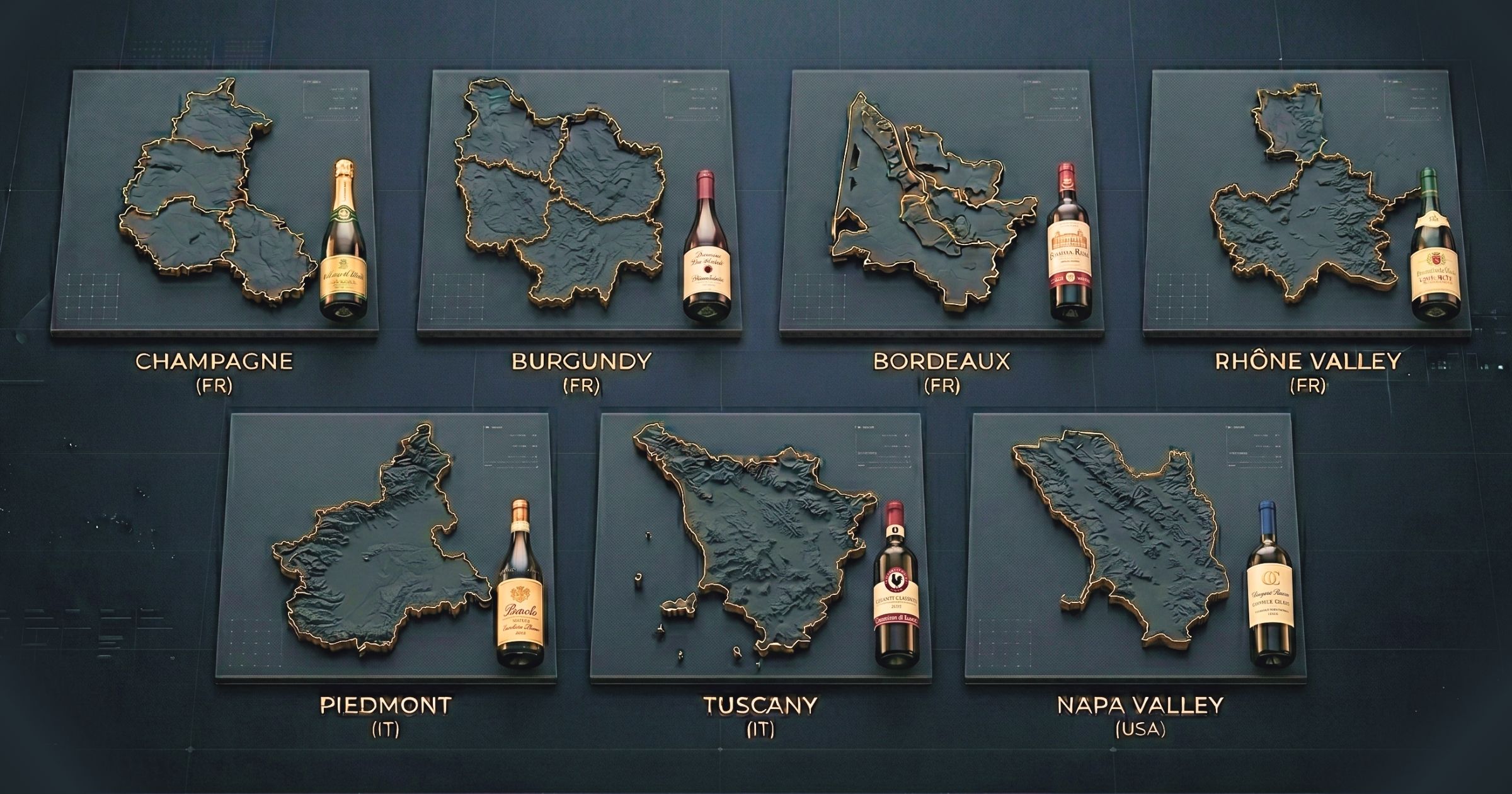
The fine wine regions most used by investors, and what each brings:
Bordeaux: the backbone of the market, deep and liquid, with a long track record.
Burgundy: tiny production and high demand have driven the strongest long-run gains, with more volatility.
Champagne: prestige cuvees offer steady demand, though they fell hard after the 2022 peak.
Italy (Super Tuscans and Piedmont): increasingly liquid and among the more resilient recent performers.
Rhône: lower entry prices and improving recognition.
Optimal investment requires matching your time horizon to the specific entry and exit windows of these regions, rather than applying a single strategy across your entire portfolio.
Which wine region is the best investment in 2026?
The fine wine market is not a uniform entity; it is a highly concentrated ecosystem where outcomes are dictated by regional variance. While exceptional wine is produced globally, only a small number of regions consistently meet the criteria required for serious, repeatable investment. These criteria include global demand, long track records, deep secondary market liquidity, and clear quality hierarchies.
At WineFi, we consider just seven regions to be truly investment-grade. These regions form the structural backbone of our investment universe, representing markets where fine wine consistently behaves like an asset rather than just a passion. When evaluating which wine region is the best investment, it is essential to understand that the investable fine wine market is relatively small, estimated at approximately $5.5bn globally.
Of all the wine produced worldwide, only a fraction of a percent can be reasonably described as investment-grade. This narrowness is a feature that reflects sustained market demand, repeatable liquidity, and recognised provenance. Consequently, an allocation strategy must focus on the specific regions that have historically proven their ability to hold and accrue value.
The foundation: How to invest in Bordeaux wine
Bordeaux is often described as the backbone of the fine wine market. For investors building a portfolio in 2026, it offers unmatched liquidity, scale, and price transparency. This stability is primarily underpinned by the historic 1855 Classification, which established a durable hierarchy of classified growths that continues to anchor global demand and pricing today.
When you invest in Bordeaux, you are participating in the largest single sub-market, which accounts for approximately 40% of secondary market trading. This immense scale, combined with an active en primeur system, makes Bordeaux the first port of call for many new investors and a core stabiliser in diversified portfolios. The most famous producers driving this market include the First Growths: Chateau Lafite Rothschild, Chateau Mouton Rothschild, Chateau Margaux, Chateau Latour, and Chateau Haut-Brion.
Bordeaux provides a reliable holding cycle. Data indicates that the optimal entry window for Bordeaux red wine is between 5 and 7 years of age. The optimal exit window is typically before 25 years of age. Understanding this specific lifecycle prevents investors from holding assets past their peak market relevance.
Scarcity and demand: How to invest in Burgundy wine
If Bordeaux represents scale and liquidity, Burgundy represents extreme scarcity and concentrated demand. Burgundy is characterised by its tiny production volumes, fragmented vineyard ownership, and cult producers, which together create highly powerful price dynamics.
Unlike Bordeaux, the classification system in Burgundy is vineyard-led rather than producer-led. Sites are ranked as Grand Cru, Premier Cru, Village, or Regional based entirely on their specific terroir. Investment-grade wines sit predominantly within the Grand Cru and Premier Cru climates, where scarcity and demand are most heavily concentrated. Famous producers that anchor Burgundy investment include Domaine de la Romanée-Conti, Domaine Leroy, Armand Rousseau, and Georges Roumier.
Because of its limited supply, Burgundy can experience higher volatility than Bordeaux, but it also offers the potential for higher returns. This makes the region a key driver of outperformance when selected carefully. The lifecycle for Burgundy is also slightly longer. For Burgundy red wine, the optimal entry window is between 5 and 9 years, with an optimal exit window extending to 20 years of age or older. For Burgundy white wine, the entry window is earlier, at 3 to 5 years, with exits optimal at 15 years and older.
For a deep dive, read our piece on how to invest in Burgundy fine wine.
The stability champions: How to invest in Champagne
Champagne was once an overlooked category in the secondary market but is now firmly established as a highly desirable alternative asset. Top Champagne combines strong brand power, increasing global consumption, and steadily improving secondary market liquidity.
The region is broadly divided into two main categories. The first is the Grand Marques, which are the large, historic houses that deliver scale, consistency, and global liquidity. The second category consists of grower Champagnes, which are produced by individual vignerons directly from their own vineyards. These grower Champagnes offer greater terroir expression and significant scarcity. Prestige cuvées from leading houses and top growers have become an important structural allocation for balanced portfolios.
Famous producers that lead the Champagne investment market include Krug, Dom Perignon, Louis Roederer Cristal, and Salon. Champagne possesses a distinct aging curve compared to still wines. Investment-grade Champagne offers both a short-term and long-term investment window, as it is released by producers only once it has entered its drinking window. This means investors can choose to sell shortly after acquisition or hold for an extended period to benefit from continued appreciation as the wine evolves further in bottle.
The Italian pillars: Tuscan and Piedmont wine investment
Italy provides two critical regions for fine wine investment: Tuscany and Piedmont. These territories offer compelling diversification benefits and have shown strong performance across recent market cycles.
Tuscany is home to some of Italy's most globally recognised wines. Super Tuscans and top Brunello producers benefit from immense brand equity, improving market depth, and consistent critical acclaim, firmly establishing Tuscany as Italy's most prominent investment region. Famous Tuscan producers include Tenuta San Guido (Sassicaia), Marchesi Antinori (Tignanello and Solaia), Biondi-Santi, and Tenuta dell'Ornellaia (Ornellaia and Masseto). Tuscan red wines have an early optimal entry window at approximately 4 years of age, with a long holding period culminating in an exit window at 22 years or older.
Piedmont is anchored by the prestigious Barolo and Barbaresco appellations. Production here is highly limited, quality is increasingly consistent, and international demand continues to deepen year over year. Historically undervalued, Piedmont has matured into a highly credible long-term investment play. Famous producers driving the Piedmont market include Giacomo Conterno, Bruno Giacosa, Bartolo Mascarello, and Angelo Gaja. The optimal entry window for Piedmont red wine is between 6 and 9 years, but the exit window becomes unpredictable after 20 years of age.
Expanding horizons: Napa Valley, the Rhône Valley, and the Rest of the World
Beyond the dominant regions of France and Italy, a select few other territories meet the strict criteria for investment-grade status.
The Rhône Valley offers a more concentrated but highly compelling investment case. The Northern Rhône in particular is known for highly limited production, long aging curves, and growing international recognition. While secondary market liquidity is narrower than that of Bordeaux or Tuscany, the quality leaders have proven their investment credentials. Famous producers include Jean-Louis Chave, E. Guigal, Thierry Allemand, and Rayas.
Napa Valley represents a brand-driven market characterised by exceptionally strong domestic demand within the United States. The top end of Napa Valley combines critical influence, cultural cachet, and intense scarcity. However, liquidity is highly selective and focused on a small group of elite producers. Famous names include Screaming Eagle, Harlan Estate, Opus One, and Dominus Estate. California red wines typically have an optimal entry window of 8 to 10 years, and an exit window beginning at 16 years of age or older.
Outside of these core regions, the Rest of the World offers highly selective opportunities. Standout examples include Australia's Penfolds Grange, which combines immense global brand power with deep secondary liquidity, and a small number of elite Spanish wines, such as Vega Sicilia and Pingus, where production, reputation, and demand align perfectly. These wines are exceptions to the rule, proving that while great wine is made globally, true investment-grade status is rare.
Understanding regional lifecycles and holding periods
Fine wine does not behave like a continuously traded financial instrument. Prices do not update continuously, and markets are not perfectly efficient. Value is realised over time rather than day to day, making fine wine closer in behaviour to residential property than to equities.
Because fundamentals move slowly and transactions are episodic, outcomes are shaped by when an asset is bought, the price paid, how long it is held, and the specific regional quality of what is owned. This structure explains why fine wine should be approached as a medium to long-term investment. Wines generally improve with age up to the peak of their drinking window, which tends to coincide with greater market interest, improving liquidity, and clearer price discovery due to increasing scarcity as bottles are consumed or damaged.
Historic data shows that as holding periods increase, average returns have tended to improve, volatility of outcomes has declined, and the probability of loss has reduced. However, market-adjusted lifecycle analysis shows a consistent pattern across regions. Many wines underperform the market in their early years, improve dramatically as they approach their drinking window, and become more dispersed at later ages as some turn into long-term collectables while others lose relevance or liquidity.
This dynamic means that a disproportionate share of excess returns is often generated in the middle years of a wine's lifecycle, and that window looks fundamentally different for Burgundy, Bordeaux, Champagne, Italy, and California. Rather than defaulting to a blanket strategy, successful allocation focuses on buying and holding wines during their highest appreciating 4 to 7 years only.
Market cycles and regional variance
The fine wine market is cyclical, and different regions respond to these cycles in unique ways. Prices do not rise steadily year after year but tend to move through periods of expansion and consolidation, where prices may pause, flatten, or reprice selectively rather than fall uniformly.
Understanding these historical cycles is crucial for regional allocation:
Between 2009 and 2011, immense interest from China created an unsustainable bubble, with prices soaring to gains of 345% by 2011 before correcting.
From 2011 to 2016, the market entered a five-year period of stagnation, heavily impacting Bordeaux, before the 2016 Brexit vote lowered the British Pound and kickstarted a market rally.
In 2019 and 2020, US tariffs on European wines over 14% ABV caused a massive shift in buying patterns, directly boosting the market share of tariff-exempt regions like Italy and Champagne.
The 2020 to 2022 pandemic boom accelerated digital trading and fueled a sharp expansion in fine wine prices, broadening demand beyond Bordeaux, with Burgundy and Champagne experiencing particularly strong gains.
From mid-2023 to the present, the market digested a prolonged correction triggered by rising interest rates, resulting in a multi-year normalisation that returned the market to a fundamentals-led footing.
By late 2025 and into 2026, data indicated clear signs of recovery and stabilisation, with increased liquidity suggesting the market may have found a bottom. Understanding how individual regions perform during these boom and bust periods is vital for structuring a resilient portfolio.
Essential preservation: Storage, provenance, and tax
Regardless of which region you select, all investment-grade wine is subject to the same strict rules of preservation and provenance. To maintain resale value, fine wine must be stored in bond, meaning it is kept within a government-approved bonded warehouse. These specialized facilities strictly control temperature at approximately 11 to 14°C, maintain humidity between 75 and 85%, and ensure minimal light exposure and low-vibration handling.
Wines held outside of these bonded conditions are generally less liquid, because buyers cannot reliably confirm the storage history or provenance. Furthermore, while wines remain in bonded storage, VAT and excise duty are considered suspended, and therefore not payable unless a client elects to take physical delivery.
For UK investors, there is also a significant regional tax consideration. Fine wine with a predictable drinking life of under 50 years is typically treated as a "wasting asset" for UK tax purposes and is therefore generally exempt from Capital Gains Tax (CGT). This includes the vast majority of dry red and white wines from Bordeaux, Burgundy, Tuscany, and other core regions. Wines with exceptionally long aging potential, such as fortified wines like Port or Sherry, and certain long-lived sweet wines, are intentionally excluded as they may fall outside the wasting asset definition.
How fine wine regions connect to your portfolio
Understanding regional variance is the key to successfully navigating the fine wine market. By combining the liquid foundation of Bordeaux with the high-growth scarcity of Burgundy and the stable brand equity of Champagne and Tuscany, investors can build a resilient, real-asset portfolio. To explore how these regional dynamics translate into actionable allocations, read the complete 2026 Fine Wine Investment Guide. If you want to start your journey, read our piece on how to start investing in fine wine. When you are ready to view expertly curated portfolios aligned with these regional lifecycles, you can explore opportunities on the WineFi homepage.
Frequently asked questions
What is the best wine region for investment?
There is no single best region, as portfolios require a mix of assets. Bordeaux acts as the foundational bedrock due to its high secondary market liquidity and scale, while Burgundy offers higher potential returns driven by extreme scarcity. A balanced approach utilises multiple core regions.
Is Bordeaux or Burgundy better for investment?
Bordeaux offers unmatched liquidity, price transparency, and predictable supply scales, making it an excellent core stabiliser. Burgundy has tiny production volumes and fragmented ownership, creating higher volatility but greater potential returns due to intense global competition for Grand Cru sites.
How long should I hold Bordeaux wine?
Historic data indicates that the optimal entry window for Bordeaux red wine is between 5 and 7 years of age. The optimal exit window to maximise returns and market liquidity is typically before 25 years of age.
Are Italian wines a good investment?
Yes, Tuscany and Piedmont are critical pillars of the investment market. Super Tuscans provide immense brand equity and stability, while the limited production of Barolo and Barbaresco in Piedmont has seen deepening international demand and consistent long-term growth.
Does Napa Valley wine hold its value?
Napa Valley wines combine critical influence with intense cultural cachet and structural scarcity. While they hold strong value, their secondary market liquidity is highly selective and heavily reliant on strong domestic demand within the United States.
Why is storage important for regional wine investment?
Regardless of the region, all fine wine must be stored in a government-approved bonded warehouse. Facilities control temperature, humidity, light, and vibration. Wines held outside bond lose secondary market liquidity because buyers cannot verify their provenance and condition.
This article is provided for general information and is not personal tax or investment advice. Capital is at risk. Wine values can go down as well as up, and investments may not perform as expected. Returns may vary. You should not invest more than you can afford to lose. WineFi is not authorised by the Financial Conduct Authority. Investments are not regulated and you will have no access to the Financial Services Compensation Scheme (FSCS) or the Financial Ombudsman Service (FOS). Past performance and forecasts are not reliable indicators of future results. Investments are illiquid. Tax treatment depends on individual circumstances and may change. You are advised to obtain appropriate tax or investment advice where necessary. WineFi is a trading name of WineFi Management Limited.




Capital is at risk. Wine values can go down as well as up, and investments may not perform as expected. Returns may vary. You should not invest more than you can afford to lose. WineFi is not authorised by the Financial Conduct Authority. Investments are not regulated and you will have no access to the Financial Services Compensation Scheme (FSCS) or the Financial Ombudsman Service (FOS). Past performance and forecasts are not reliable indicators of future results and should not be relied on. Forecasts are based on WineFi’s own internal calculations and opinions and may change. Investments are illiquid. Once invested, you are committed for the full term. Tax treatment depends on individual circumstances and may change.
You are advised to obtain appropriate tax or investment advice where necessary.
WineFi is a trading name of WineFi Management Limited. Registered in England and Wales with registration number: 14864655 and whose registered office is at 5th Floor, 167-169 Great Portland Street, London, United Kingdom, W1W 5PF.