


TL;DR
Bordeaux remains the largest and most liquid fine wine market in the world, accounting for around 35 percent of total traded value on Liv-ex as at the start of 2026. It is the bedrock of fine wine investment: the deepest secondary market, the strongest brand recognition, and the longest track record of any region.
That said, the past three years have been difficult. The Liv-ex Bordeaux 500 fell 6.7 percent in 2025, the Liv-ex 50, which tracks the First Growths, has been in a consistent decline for 33 months, and the en primeur system has come under serious strain as buyers compare new releases against widely available back vintages at lower prices. The 2025 vintage campaign, currently being released, is widely seen as a test of pricing discipline for the region.
This guide walks through what Bordeaux actually is as an investment region, how its classification systems work, which producers drive the market, how to think about vintages and en primeur, what the 2026 market context looks like, and where Bordeaux fits in a long-term fine wine portfolio. The honest framing is that Bordeaux is going through a structural correction. For disciplined investors, that correction is creating selective entry points.
Why Bordeaux still matters
The case for Bordeaux is not that it has been the best-performing fine wine region of the past decade. It has not. Champagne, Burgundy, and the Rest of the World indices have all outperformed it on price over various windows. The case for Bordeaux is structural.
First, liquidity. The Bordeaux secondary market is the deepest of any fine wine region by a wide margin. Liv-ex data show Bordeaux accounting for roughly 35 percent of total traded value as at the start of 2026, with that share stable in the 30 to 40 percent range over the past four years. By comparison, Burgundy, Champagne, and Italy each sit in single-digit to low-teens shares of value traded. For investors who care about being able to sell when they want to, Bordeaux's depth is the single most important feature of the region.
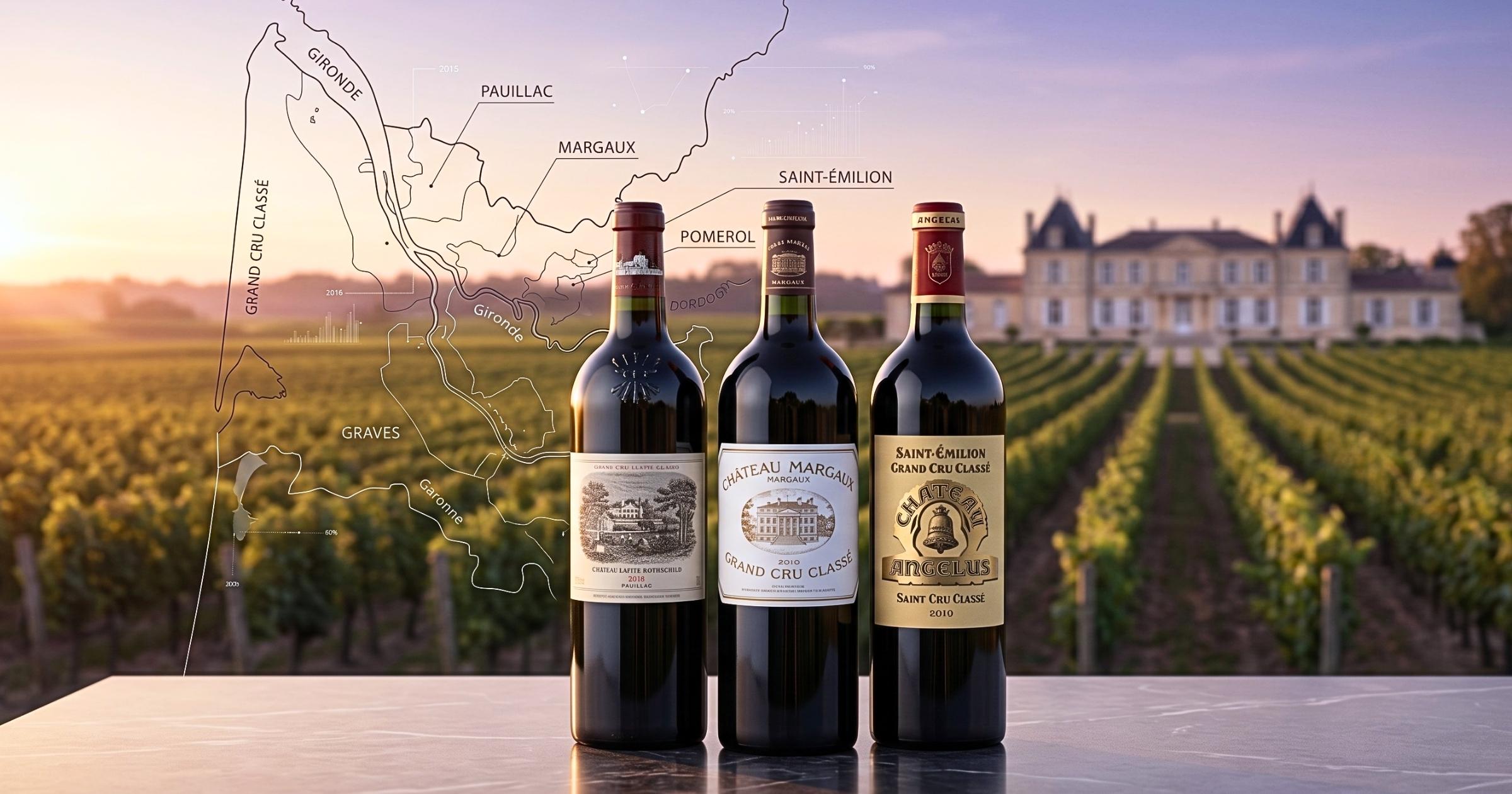
Second, brand recognition. The First Growth châteaux of the 1855 Classification, Lafite Rothschild, Latour, Margaux, Mouton Rothschild, and Haut-Brion, are arguably the strongest brands in fine wine globally. They sell across every major wine market, attract bids in every auction, and produce a consistent supply that can be valued against decades of pricing data.
Third, transparency. Bordeaux has more publicly available pricing data, vintage assessments, and trade flow visibility than any other fine wine region. The Liv-ex Bordeaux 500 has six sub-indices, including the Fine Wine 50 for First Growths, the Right Bank 50 and 100, the Left Bank 200, the Second Wine 50, and the Sauternes 50, all of which give investors a structural read on different slices of the market.
Bordeaux is not the region that will produce the best absolute returns in most cycles. It is the region that anchors the portfolio.
The classification systems
Bordeaux's commercial structure rests on a series of classification systems that have evolved over more than 150 years. Investors do not need to memorise the detail, but they do need to understand the broad shape.
The 1855 Classification
Commissioned by Napoleon III for the Paris Universal Exhibition, the 1855 Classification ranks 61 châteaux of the Left Bank, primarily in the Médoc plus Château Haut-Brion in Pessac-Léognan, into five tiers from First to Fifth Growth (Premier Cru to Cinquième Cru). The classification has changed only once, in 1973, when Mouton Rothschild was elevated from Second to First Growth. The five First Growths and a number of high-performing Second Growths are the workhorse of the investment-grade Left Bank.
Saint-Émilion Classification
Saint-Émilion, on the Right Bank, maintains its own classification that is revised approximately every ten years. The top tier, Premier Grand Cru Classé A, has historically included Cheval Blanc, Ausone, Angélus, and Pavie, though several producers, including Cheval Blanc, Ausone, and Angélus, have withdrawn from the most recent classifications. The fluid status of the Saint-Émilion classification has reduced its commercial weight relative to the static 1855 Classification.
The Right Bank's unclassified greats
Pomerol, also on the Right Bank, has no official classification system at all. Its most famous estates, including Pétrus and Le Pin, are commercially priced as among the most expensive wines in the world despite holding no classified status. Their market position rests on production scarcity, critical scores, and decades of buyer behaviour rather than any formal hierarchy.
Cru Bourgeois
Below the 1855 Classification on the Left Bank, the Cru Bourgeois ranking covers a much larger number of estates and is reviewed annually. It is generally a category for drinking rather than investment, though selected wines have a small secondary market.
For investment purposes, the practical filter is straightforward. The First Growths and a handful of consistent Super Seconds on the Left Bank, plus the small group of high-status Right Bank names, account for the overwhelming majority of investment-grade Bordeaux traded on the secondary market.
The producers that drive the market
A relatively small number of estates account for most of the investment-grade flow. The categorisation below is conventional rather than official.
The First Growths
Château Lafite Rothschild, Château Latour, Château Margaux, Château Mouton Rothschild, and Château Haut-Brion. These five estates form the core of the Liv-ex Fine Wine 50 index. They are the most liquid Bordeaux names and the most resilient through downturns, though all five have participated in the 33-month decline of the Liv-ex 50.
The Super Seconds
A loose grouping of high-performing Second Growths and equivalent estates that trade close to First Growth pricing in strong vintages. The conventional list includes Château Léoville-Las Cases, Château Pichon-Longueville Comtesse de Lalande, Château Pichon-Longueville Baron, Château Cos d'Estournel, Château Ducru-Beaucaillou, and Château Léoville-Barton. These wines often offer better relative value than the First Growths and form a significant share of investment-grade Left Bank trading.
The Right Bank prestige names
Château Pétrus, Le Pin, Château Cheval Blanc, Château Ausone, and Château Lafleur. Production volumes are small, prices are high, and the secondary market is thinner than the Left Bank's. These wines tend to behave more like Burgundy in price profile than like the rest of Bordeaux.
Sauternes
The sweet wine appellation, anchored by Château d'Yquem, has a smaller and more specialist market. The Sauternes 50 sub-index tracks it. Allocation tends to be a portfolio decision rather than a default holding.
For most fine wine portfolios, exposure to Bordeaux is built primarily through the First Growths and Super Seconds, with selective Right Bank holdings layered in for diversification within the region.
Understanding Bordeaux vintages
Vintage matters more in Bordeaux than in most fine wine regions. The variability of climate, particularly rainfall during harvest, produces meaningful year-to-year differences in quality. The market prices vintages accordingly.
Investment-grade vintages over the past two decades that have generally traded well include 2000, 2005, 2009, 2010, 2015, 2016, and 2019. These are the vintages that combine high critical scores with reasonable initial pricing, the two ingredients that produce long-term appreciation.
Vintages that have been more difficult investments include 2011, 2012, 2013, and 2017, where lower critic scores or higher release prices, or both, suppressed secondary market interest.
The 2022 vintage was widely praised on quality but received tepid commercial uptake at the prices châteaux initially set. The 2023 and 2024 campaigns saw significant price cuts as estates tried to revive demand. The 2025 vintage, currently being released, is described by trade press as a small, high-quality crop reminiscent of 2019, with pricing expected to remain near 2024 levels.
The takeaway is that vintage quality alone does not produce investment returns. Vintage quality combined with disciplined release pricing does. Investors should resist the temptation to buy weak vintages cheaply or strong vintages expensively, and instead look for the alignment.
En primeur in 2026: a system under strain
En primeur is the system by which Bordeaux châteaux sell their wines as futures during the spring after harvest, while the wine is still ageing in barrel. The theory is that early buyers secure stock at a price below where the wine will eventually trade once bottled. The practice, particularly over the past decade, has been more complicated.
The system has come under serious strain. Liv-ex described the en primeur process in April 2026 as facing "a test of price discipline," with merchants reporting that collectors have been "burned by repeated promises of strong returns while portfolios continued to lose value." Several merchants have stepped away from en primeur participation entirely.
The structural problem is straightforward. For an en primeur purchase to make commercial sense, the release price must be lower than the eventual market price of the bottled wine. Over the past several vintages, that has frequently not been the case. Back vintages of comparable quality have remained available at lower prices than new releases, which has eroded the rational basis for early commitment.
The 2024 campaign saw châteaux cutting release prices materially compared to the previous year. The 2025 campaign, now in progress, faces similar pressure despite a smaller, higher-quality vintage. Cheval Blanc broke from the consensus with a significant price increase early in the campaign, drawing critical commentary. Most châteaux were expected to hold pricing close to 2024 levels.
For investors in 2026, the en primeur question is best approached with discipline. The system can still work, but only where release pricing offers a clear discount to currently-available back vintages of comparable quality. Where that condition is not met, buying back vintages on the secondary market is often the better choice.
How Bordeaux has performed
The honest performance story is that Bordeaux has underperformed broader fine wine over the past three years.
The Liv-ex Bordeaux 500 was down 6.7 percent in 2025. The Liv-ex Fine Wine 50, which tracks the First Growths, has been in a consistent decline for 33 months as of mid-2025. The broader Liv-ex 1000 was down 4.5 percent in 2025, slightly less negative than Bordeaux, indicating that other regions including Italy and Rest of the World have held up better.
Stretching the lens to five years, the picture is similar. Bordeaux's share of total Liv-ex trading volume has declined from over 70 percent in the early 2000s to around 35 percent today, a meaningful structural rebalancing of the market toward Burgundy, Champagne, and the rest of the world.
This is not the picture a marketing pitch typically presents. It is the honest read, and it matters because it shapes how Bordeaux should sit in a portfolio today. For investors who held Bordeaux through the 2020 to 2022 peak and the subsequent correction, the past several years have been frustrating. For investors building positions in 2026, the same correction has produced lower entry points across the First Growths and Super Seconds than have been available at any point in the past five years. Whether that represents a genuine value opportunity or a value trap depends on whether the structural rebalancing continues or stabilises.
How to buy Bordeaux for investment
The mechanics of buying Bordeaux differ by route, and provenance matters more than first-time investors typically appreciate.
Specialist merchants
Established Bordeaux specialists such as Berry Bros & Rudd, Justerini & Brooks, Bordeaux Index, and Farr Vintners are long-standing intermediaries between the Place de Bordeaux and end buyers. They handle both en primeur allocations and secondary market sales. Their pricing is generally transparent and their provenance documentation is strong. For investors building positions directly, these merchants are the primary channel.
Auction houses
Christie's, Sotheby's, Bonhams, and others run regular fine wine auctions where back-vintage Bordeaux trades. Auctions offer access to rare older vintages and can produce both bargains and premiums depending on conditions. Buyer's premium typically runs 20 to 25 percent on top of the hammer price, which materially affects the all-in cost.
Investment platforms
Platforms such as WineFi acquire investment-grade wines on behalf of investors and handle storage, insurance, and eventual exit. The advantage is professional sourcing, provenance verification, and access to allocations that retail buyers often cannot secure directly. The trade-off is that the platform's fee structure must be understood and compared against direct purchasing.
Bonded storage
Wines purchased in bond, which means stored in a government-approved bonded warehouse before VAT and duty are paid, retain a clean provenance trail and can be sold in bond without incurring tax. Storage in bond is effectively mandatory for investment-grade Bordeaux. Wines that have left bond, particularly into private cellars, carry a meaningful provenance discount on resale.
For investors new to the category, our step-by-step guide to starting a fine wine investment in the UK walks through the practical process in more detail.
Where Bordeaux fits in a fine wine portfolio today
The role of Bordeaux in a fine wine portfolio has shifted over the past decade. Where Bordeaux was once the default majority allocation for any fine wine investor, the rise of Burgundy and Champagne as significant return generators, combined with Bordeaux's recent underperformance, has reshaped the conversation.
The current consensus among professional fine wine managers, reflected in published model portfolios from several large platforms, is that Bordeaux should form a meaningful part of a diversified wine allocation, particularly for those who value liquidity. The remainder is typically split across Burgundy, Champagne, Italy, and selected Rest of the World names.
The argument for keeping a meaningful Bordeaux allocation, even after a difficult three years, is that the region's liquidity and brand depth make it the most reliable component of a long-term fine wine portfolio. Other regions may produce higher returns in good cycles. Bordeaux is the most likely to be sellable, in size, when needed.
For broader context on fine wine as an asset class, our 2026 guide to fine wine as an investment covers the structural drivers of returns across regions.
Frequently asked questions
Is Bordeaux still a good investment in 2026?
Bordeaux has underperformed the broader fine wine market over the past three years. The Liv-ex Bordeaux 500 fell 6.7 percent in 2025 and the Liv-ex 50, which tracks the First Growths, has been in a consistent decline for 33 months. That said, Bordeaux remains the largest and most liquid fine wine market, accounting for around 35 percent of total Liv-ex traded value. The case for Bordeaux is structural depth and brand recognition rather than recent return, and the current correction has produced lower entry points than have been available for several years.
What are the Bordeaux First Growths?
The First Growths are the five Left Bank châteaux ranked at the top of the 1855 Classification: Château Lafite Rothschild, Château Latour, Château Margaux, Château Mouton Rothschild, and Château Haut-Brion. Mouton Rothschild was elevated from Second to First Growth in 1973, the only revision to the classification since 1855. These five estates form the core of the Liv-ex Fine Wine 50 index and are the most liquid wines in the secondary market.
What is the difference between Left Bank and Right Bank Bordeaux?
The Left Bank, which includes the Médoc and Pessac-Léognan, is predominantly planted with Cabernet Sauvignon and produces structured, tannic wines built for long ageing. It is the home of the 1855 Classification and the First Growths. The Right Bank, which includes Saint-Émilion and Pomerol, is predominantly Merlot-based and produces softer, more approachable wines. The Right Bank's top estates, including Pétrus and Le Pin, trade at among the highest prices in fine wine despite being unclassified.
Should I buy Bordeaux en primeur or wait for physical release?
The decision depends on relative pricing. For en primeur to make commercial sense, the release price must be lower than the eventual market price of the bottled wine. Over the past several vintages, that has frequently not been the case, with back vintages of comparable quality remaining available at lower prices than new releases. The 2025 vintage campaign is being watched closely as a test of whether châteaux can restore the rational basis for early buying. For most investors, the disciplined approach is to buy en primeur only where release pricing offers a clear discount to currently-available back vintages.
What is the 1855 Classification?
The 1855 Classification is a ranking of 61 Bordeaux châteaux from the Left Bank, primarily in the Médoc, into five tiers from First Growth to Fifth Growth. It was commissioned by Napoleon III for the Paris Universal Exhibition of 1855 and has remained essentially unchanged, with one revision in 1973 elevating Mouton Rothschild from Second to First Growth. It is the most enduring and commercially important classification in fine wine.
How has Bordeaux performed against other fine wine regions?
Over the past decade, Bordeaux has underperformed Champagne, Burgundy, and the Rest of the World on price index basis. Its share of total Liv-ex trading volume has declined from over 70 percent in the early 2000s to around 35 percent today. Bordeaux's strengths are structural rather than performance-led: it offers the deepest secondary market, the strongest brand recognition, and the most transparent pricing data of any fine wine region.
What's the minimum to start investing in Bordeaux?
There is no formal minimum, but practical entry points vary by route. A single case of an investment-grade Bordeaux, for example a Super Second from a strong vintage, can cost anywhere from £1,000+. First Growth case prices typically run from £2,000+ depending on producer and vintage. Investment platforms can offer fractional or shared access to wines that would be difficult to acquire directly, lowering the practical entry point. Storage and insurance costs should be factored into the total.
This article is provided for general information and is not personal tax or investment advice. Capital is at risk. Wine values can go down as well as up, and investments may not perform as expected. Returns may vary. You should not invest more than you can afford to lose. WineFi is not authorised by the Financial Conduct Authority. Investments are not regulated and you will have no access to the Financial Services Compensation Scheme (FSCS) or the Financial Ombudsman Service (FOS). Past performance and forecasts are not reliable indicators of future results. Investments are illiquid. Tax treatment depends on individual circumstances and may change. You are advised to obtain appropriate tax or investment advice where necessary. WineFi is a trading name of WineFi Management Limited.




Capital is at risk. Wine values can go down as well as up, and investments may not perform as expected. Returns may vary. You should not invest more than you can afford to lose. WineFi is not authorised by the Financial Conduct Authority. Investments are not regulated and you will have no access to the Financial Services Compensation Scheme (FSCS) or the Financial Ombudsman Service (FOS). Past performance and forecasts are not reliable indicators of future results and should not be relied on. Forecasts are based on WineFi’s own internal calculations and opinions and may change. Investments are illiquid. Once invested, you are committed for the full term. Tax treatment depends on individual circumstances and may change.
You are advised to obtain appropriate tax or investment advice where necessary.
WineFi is a trading name of WineFi Management Limited. Registered in England and Wales with registration number: 14864655 and whose registered office is at 5th Floor, 167-169 Great Portland Street, London, United Kingdom, W1W 5PF.