



TL;DR
The second quarter of 2026 marks another step forward in the fine wine market recovery. The WineFi Trade Price Index rose by 4.4 percent, representing the largest quarterly increase since early 2022. This gain is led by auction rooms, where prices for older, rarer, and premium wines are rising. Market liquidity is improving steadily, bid offer spreads are narrowing to their tightest of the cycle, and trade discounts have closed to 2.4 percent. The data points toward a firming market driven by collectors acquiring mature investment-grade wine. Read this article for an overview of the market, and download the full report here.
How did fine wine prices perform in Q2 2026?
Realised transaction prices across the most liquid investment-grade wines continued to improve into the second quarter of 2026. The WineFi Trade Price Index rose 4.4 percent in the quarter to reach a value of 99.7.
This represents the biggest quarterly gain since the first quarter of 2022. The index now stands 9.5 percent above its trough recorded in the second quarter of 2025.
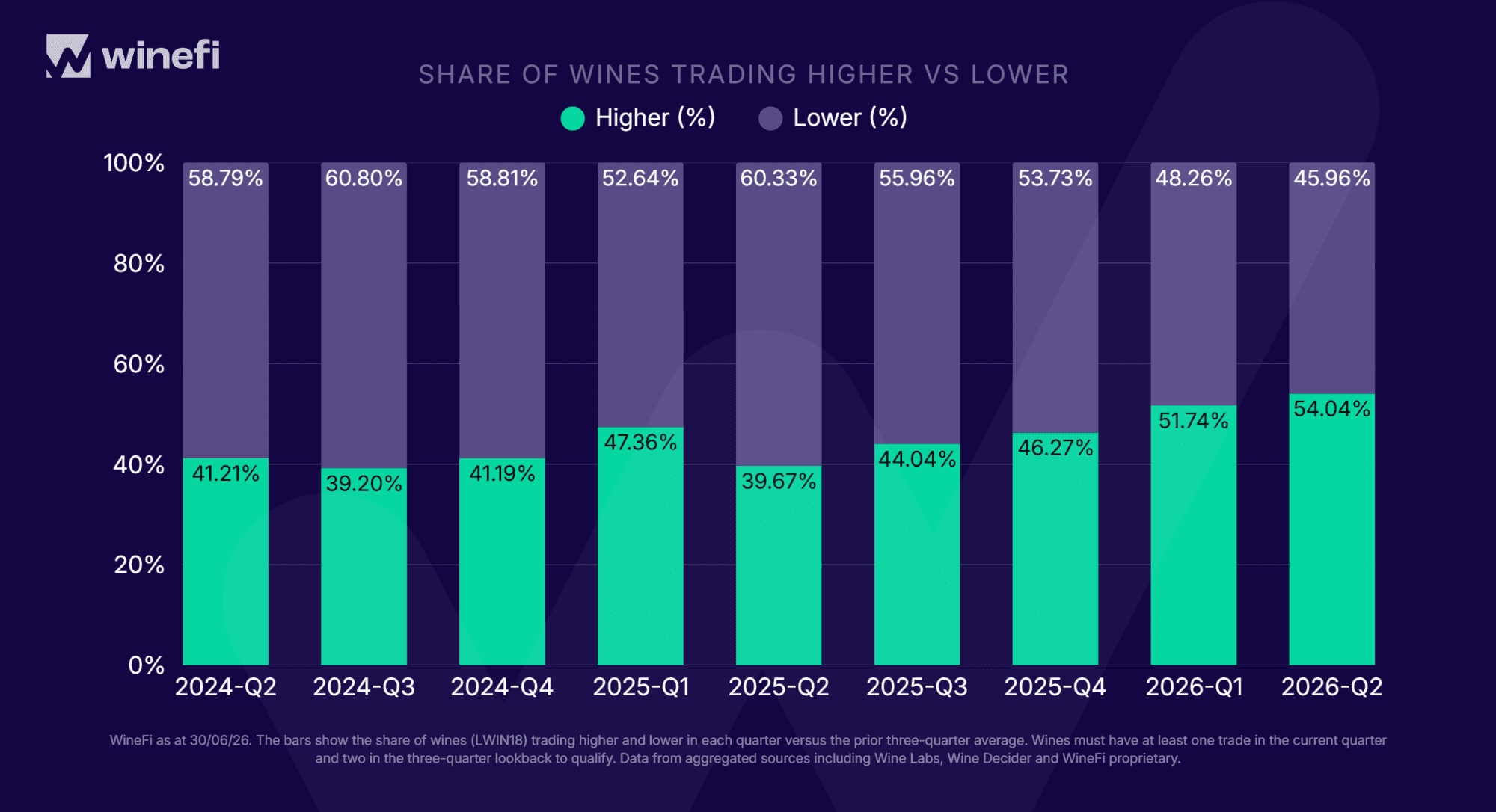
A majority of investment-grade wines recorded higher realised trade prices quarter on quarter. Specifically, 54.04 percent of tracked wines traded higher, against 45.96 percent trading lower. The balance has favoured risers for two consecutive periods. The net margin of risers over fallers has widened to 8 percent, up from 3.5 percent in the prior quarter. The proportion of wines trading higher has now risen for four consecutive quarters, recovering from a low of 39.20 percent in the third quarter of 2024. This steady upward move corroborates the recovery evident across the broader trade based indices.
Why are auction prices outperforming exchange prices?
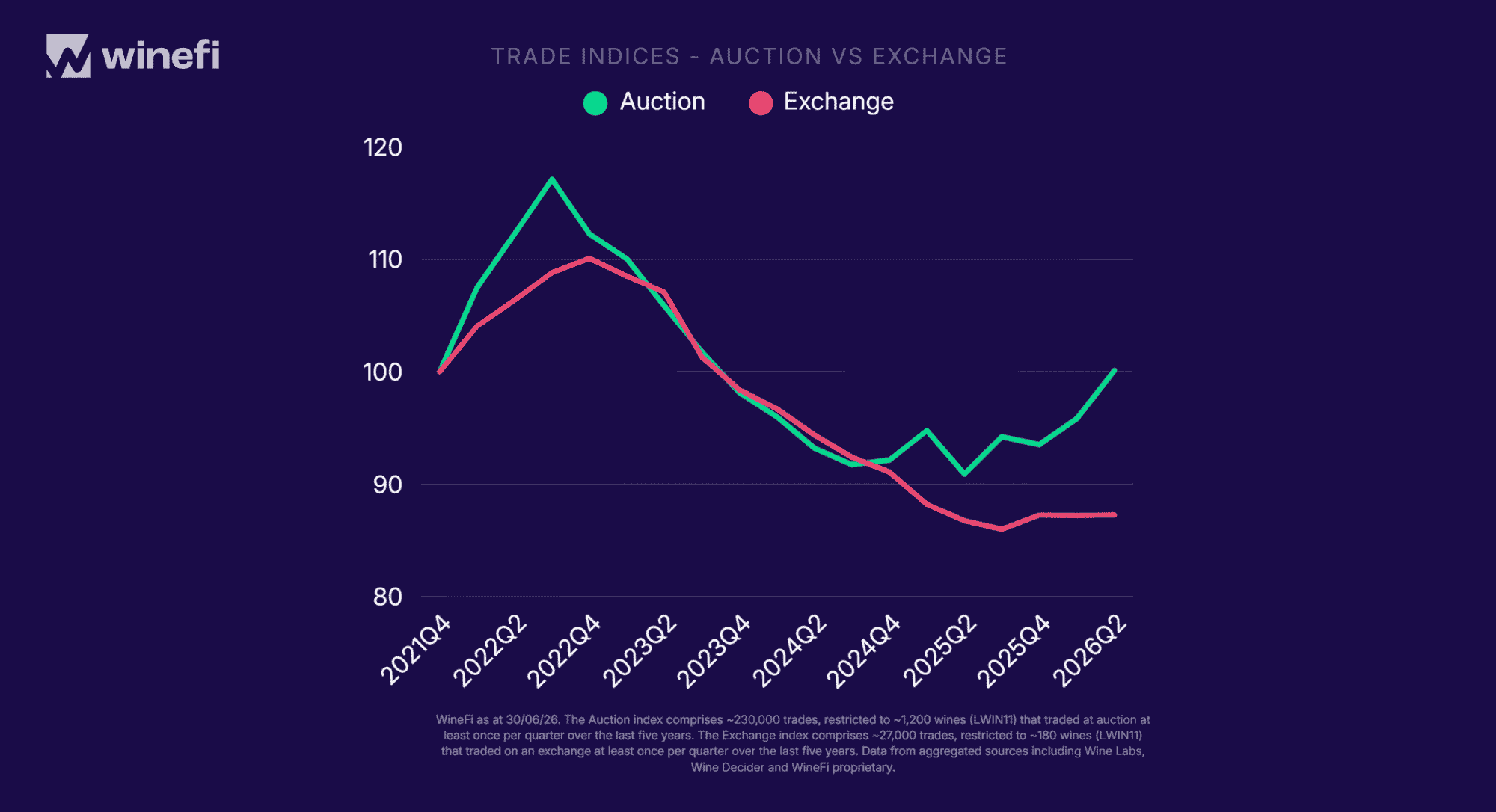
The auction based index rose 4.5 percent in the quarter, marking its strongest reading of the market recovery. In contrast, exchange prices held comparatively steady, recording only a 0.2 percent increase over the same period.
Auction and exchange prices have diverged significantly over the cycle. The gap between the two channels has extended to approximately 15 index points, which is the widest divergence since the series was rebased.
This channel divergence is fundamentally driven by differences in composition. The auction market naturally clears the older, scarcer, and higher priced wines that are currently leading the market recovery. Exchange trading, on the other hand, heavily skews toward younger labels with higher available supply. Because the wines carrying the recovery are older and trade more frequently at auction, the auction index is capturing the upward momentum much faster than exchange based metrics.
Are buyers meeting sellers at market prices?
The trade discount to market price narrowed to 2.4 percent, which is its narrowest reading in close to five years.
The trade discount measures how far realised transaction prices sit below prevailing market prices. A wider discount reflects sellers conceding on price to clear stock, while a narrower one reflects buyers actively meeting the market. Having widened to nearly 15 percent at the depth of the downturn in late 2023, the discount has closed significantly, down from approximately 9.5 percent a year earlier. The narrowing discount points to a highly functional market in which realised and quoted prices are converging.
Liquidity metrics are also improving across the board. Both the mean and median bid offer spreads narrowed further in the second quarter of 2026, reaching their tightest levels in the recorded series. The mean bid offer spread tightened to 9.8 percent, down from 12.0 percent in the prior quarter and a peak of 22.4 percent in the fourth quarter of 2024.
Buyer demand has strengthened significantly over the past twelve months. The bid to offer ratio, which measures the total value of live bids relative to offers, has advanced year on year across every index tracked. The Liv-ex Fine Wine 50 leads this metric at 1.12, meaning it is the only index in which bid value actively exceeds offers. The Burgundy 150 index recorded the sharpest twelve month recovery, more than tripling its ratio from 0.23 to 0.78.
Why are older vintages leading the fine wine recovery?
Breaking down the performance of the investment universe by age reveals that wines 16 or more years from vintage have recovered the fastest. This oldest cohort has recovered to the highest level of the three tracked age bands and significantly outperformed younger age groups.
For these older fine wines, many have entered their optimal drinking window. Increasing consumption permanently reduces the available supply, creating greater scarcity and supporting stronger price appreciation.
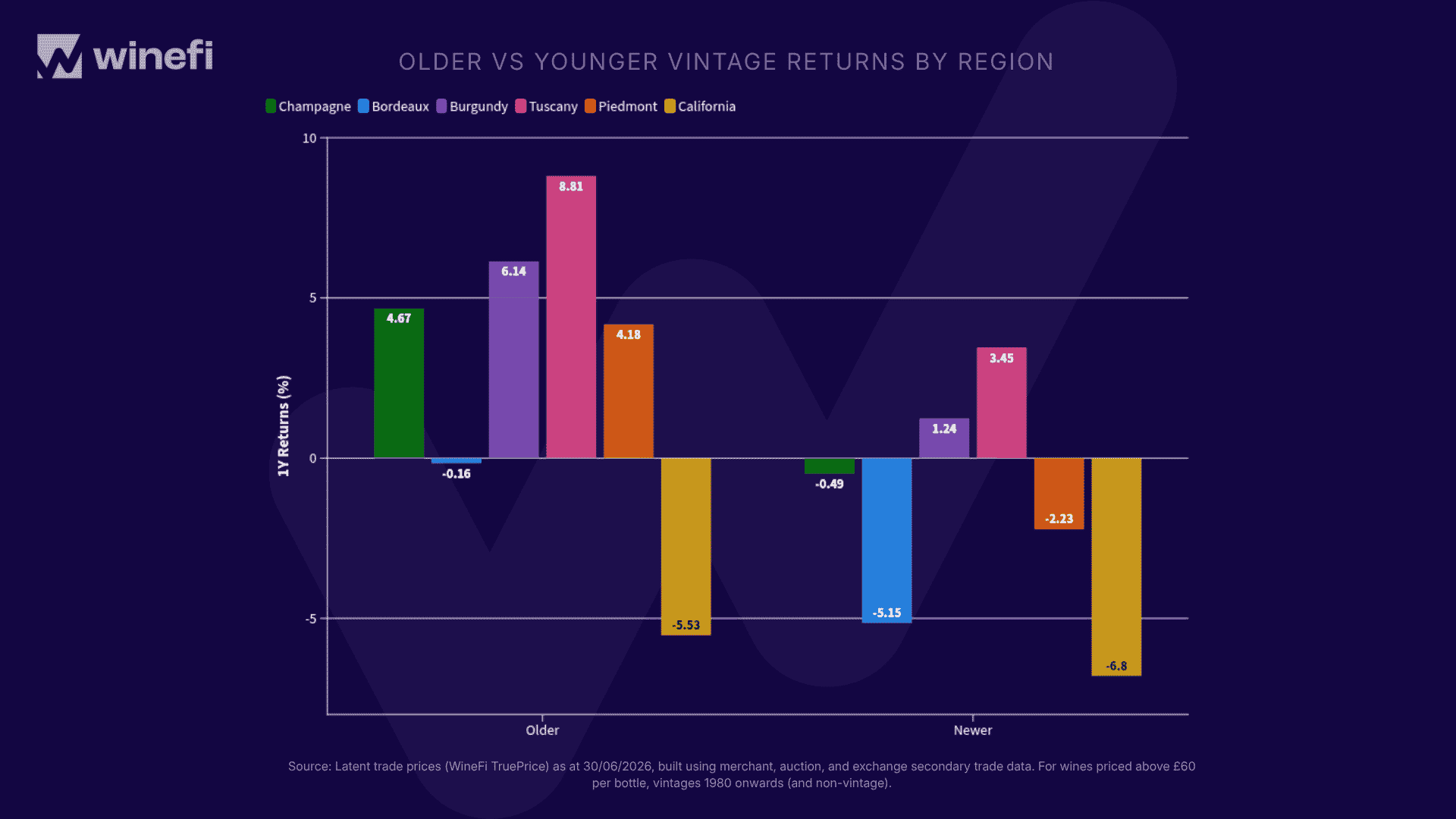
When analysing one year performance across every major fine wine region, the age effect is directionally consistent. Older wines have outperformed their younger counterparts over the past twelve months across all six major regions, indicating a market wide dynamic rather than a regionally specific instance. Mature Tuscany led the regions at a positive 8.81 percent return, followed closely by mature Burgundy at 6.14 percent and Champagne at 4.67 percent. Newer vintages, meanwhile, generated negative returns in most regions, with newer California wines down 6.8 percent.
How is the premium wine sector performing?
Segmenting the universe by price reveals a clear relationship between price and volatility. The most premium cohort, consisting of wines priced at £400 and above per bottle, has rebounded faster than lower priced categories since mid 2025.
Over the past twelve months, the £400 plus per bottle bracket returned positive 9.2 percent. The premium band has risen 9.3 percent from its May 2025 low, while the lower priced bands have recovered by less than two percentage points over the identical period.
This outperformance is an early indication that the recovery is taking hold. The greater amplitude of the premium band through the cycle is entirely consistent with the higher beta behaviour of premium wines, which tend to lead both the market correction and the subsequent recovery phase.

Which wine regions are driving the market in 2026?
Champagne has returned an average of 6 percent over the past twelve months, making it the strongest performing major region. The premium segment of Champagne was positive in every single quarter. Mature, ultra premium Champagnes that are eighteen years and older and priced above £400 per bottle have appreciated by approximately 9 percent over the same period. This robust strength reflects rising collector demand for premium, ready to drink Champagnes from the most sought after houses.
In stark contrast, young Bordeaux has been the market's weakest cohort. With the 2025 En Primeur campaign concluded, the disconnect between primary and secondary pricing persists. Despite the smallest harvest since 1991 and strong critical acclaim, many 2025 releases were priced well above comparable back vintages.
The strongest historical price appreciation has consistently come from mature Bordeaux, where declining supply, increasing scarcity, and peak drinking demand drive returns. Since June 2021, mature Bordeaux of 20 plus years has outperformed young Bordeaux of 0 to 10 years by a margin of 19 percent.
How this connects to your portfolio
The data from the second quarter of 2026 reinforces the importance of structured portfolio management in fine wine. The recovery is clearly visible, but it is not uniformly distributed. Relying on average market benchmarks will not capture the growth occurring in the auction market, mature vintages, and the premium pricing tier.
For investors with shorter horizons, portfolios should be diversified across mature, already made wines from pre 2010 vintages, as these have consistently demonstrated the capacity to outpace younger stock. Focusing exclusively on newly released vintages, such as Bordeaux En Primeur, risks overlooking where the majority of long term investment performance is generated. To explore how WineFi constructs data driven portfolios tailored to these market realities, read our guide on How to Start Investing in Fine Wine. We also invite you to review our current fine wine investment opportunities.
Frequently asked questions
Is the fine wine market recovering in 2026?
Yes, the fine wine market is demonstrating recovery in 2026. The WineFi Trade Price Index rose 4.4 percent in the second quarter, marking the biggest quarterly gain since early 2022. Furthermore, a clear majority of investment-grade wines recorded higher realised trade prices quarter on quarter, with 54.04 percent trading higher against 45.96 percent trading lower. The index now stands 9.5 percent above its mid 2025 trough.
What does the narrowing trade discount mean for investors?
The trade discount to market price narrowed to 2.4 percent in Q2 2026, its tightest level in nearly five years. This metric measures how far realised transaction prices sit below prevailing market prices. A narrower discount indicates that buyers are actively meeting sellers at market prices, rather than sellers conceding heavily to clear stock. This points to a highly functional, confident market where quoted prices accurately reflect reality.
Are fine wine bid offer spreads tightening?
Yes, market liquidity is improving rapidly. Both the mean and median bid offer spreads narrowed further in the second quarter of 2026, reaching their tightest levels of the current market cycle. The mean bid offer spread tightened to 9.8 percent, down significantly from 22.4 percent in late 2024. Narrowing spreads allow trades to clear much more efficiently and signal growing price consensus across the fine wine market.
Should I invest in older or younger wine vintages?
Current data strongly favours older vintages. Wines that are 16 or more years from vintage have recovered the fastest and significantly outpaced younger age groups across all six major regions. As mature wines enter their optimal drinking window, consumption reduces the available supply. This creates greater structural scarcity, which historically supports stronger price appreciation compared to younger wines that still have abundant supply.
Are premium wines a good investment right now?
The premium sector is currently leading the market recovery. Wines priced at £400 and above per bottle delivered a positive 9.2 percent return over the past twelve months. In comparison, lower priced bands generated returns near zero. Premium wines historically display higher beta behaviour, meaning they tend to fall sharper during corrections but rebound significantly faster when the market begins to recover.
How has Champagne performed over the past year?
Champagne is the strongest performing major region over the past year, returning an average of 6 percent. The growth is heavily concentrated in the premium segment, which was positive in every quarter. Mature, ultra premium Champagnes aged 18 years and older, priced above £400 per bottle, have appreciated by approximately 9 percent, reflecting rising collector demand for ready to drink bottles from prestigious houses.
Is Bordeaux En Primeur a good investment strategy in 2026?
Young Bordeaux has been the market's weakest cohort, and the 2025 En Primeur campaign highlighted a persistent disconnect between primary and secondary pricing. Many newly released 2025 wines were priced above comparable, ready to drink back vintages. From an investment perspective, mature Bordeaux has consistently driven the strongest historical price appreciation, outperforming young Bordeaux by 19 percent since June 2021.
This article is provided for general information and is not personal tax or investment advice. Capital is at risk. Wine values can go down as well as up, and investments may not perform as expected. Returns may vary. You should not invest more than you can afford to lose. WineFi is not authorised by the Financial Conduct Authority. Investments are not regulated and you will have no access to the Financial Services Compensation Scheme (FSCS) or the Financial Ombudsman Service (FOS). Past performance and forecasts are not reliable indicators of future results. Investments are illiquid. Tax treatment depends on individual circumstances and may change. You are advised to obtain appropriate tax or investment advice where necessary. WineFi is a trading name of WineFi Management Limited.




Capital is at risk. Wine values can go down as well as up, and investments may not perform as expected. Returns may vary. You should not invest more than you can afford to lose. WineFi is not authorised by the Financial Conduct Authority. Investments are not regulated and you will have no access to the Financial Services Compensation Scheme (FSCS) or the Financial Ombudsman Service (FOS). Past performance and forecasts are not reliable indicators of future results and should not be relied on. Forecasts are based on WineFi’s own internal calculations and opinions and may change. Investments are illiquid. Once invested, you are committed for the full term. Tax treatment depends on individual circumstances and may change.
You are advised to obtain appropriate tax or investment advice where necessary.
WineFi is a trading name of WineFi Management Limited. Registered in England and Wales with registration number: 14864655 and whose registered office is at 5th Floor, 167-169 Great Portland Street, London, United Kingdom, W1W 5PF.