



TL;DR
Tuscan wine represents Italy's most established investment region, anchored by the global liquidity of Super Tuscans like Sassicaia and Tignanello. Top-end Tuscan wines are characterised by consistent returns, highly resilient with almost defensive like characteristics, and strong secondary market liquidity. The optimal investment strategy involves acquiring Tuscan reds at approximately four years of age and holding them for an exit window at 22 years or older to capture consumption-driven scarcity.
How to Invest in Tuscan Wine
Learning how to start investing in fine wine requires an understanding that the vast majority of global wine production is entirely unsuitable for capital allocation. Tuscany, however, stands out as one of the best wine regions for investment that consistently meets the stringent criteria required for serious, repeatable investment. The region offers a combination of global demand, long track records, and deep secondary market liquidity.
Unlike traditional financial assets, fine wine is a physical, non-yielding real asset. Returns depend entirely on the ability to sell the wine at a higher price in the future. Consequently, investing in Tuscan wine is not about selecting bottles based on personal taste; it is about systematic analysis. Investors must evaluate supply constraints, historical pricing data, and the liquidity profile of specific producers.
The Italian fine wine market is distinct from how you might approach regions like Bordeaux or Burgundy. While Bordeaux relies on a historic, rigid classification system established in 1855, Tuscany's investment landscape was forged through rebellion against traditional appellation rules. This dynamic history has created a modern market where brand equity and critical acclaim drive value just as forcefully as terroir. Navigating this market requires focusing heavily on a select group of elite producers whose wines are recognised globally and traded consistently on major exchanges.
Why are Super Tuscans the backbone of Italy's fine wine market?
The foundation of Tuscan fine wine investment rests almost entirely on the Super Tuscan movement. Super Tuscans, including iconic labels such as Sassicaia, Tignanello, Solaia, Ornellaia, and Masseto, dominate Italian wine trading on the secondary market. These specific wines provide the necessary scale and price transparency that institutional and private investors require.
The movement began when visionary producers, frustrated by strict local regulations that mandated the use of indigenous grapes, began experimenting with international varieties. Producers planted Cabernet Sauvignon, Cabernet Franc, and Merlot, blending them with native Sangiovese or bottling them as pure expressions. Because these wines violated regional laws, they were initially labeled with the lowest classification available (Vino da Tavola or IGT), yet their quality vastly exceeded traditional offerings.
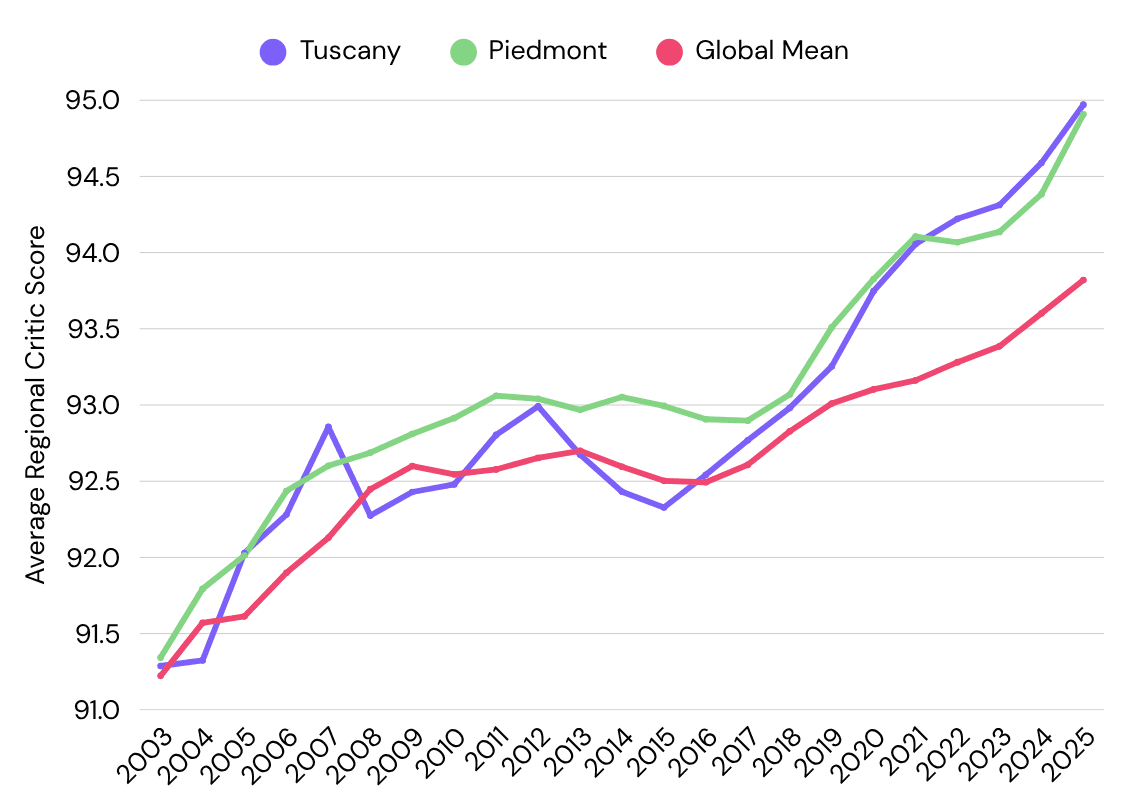
The turning point occurred when these unclassified wines began outperforming established French and Californian competitors in international blind tastings. The market quickly recognised their exceptional quality, leading to explosive demand. Today, the Super Tuscans benefit from immense brand power, improving market depth, and consistent critical acclaim. Italy’s share of global critic reviews has ballooned from 4.4% in 2003 to 12.4% by 2025, with Tuscany achieving a dominant average regional critic score of 94.97. They act as the liquidity engine for the entire Italian fine wine category, making Tuscany Italy's most established and secure investment region. For investors, holding these specific producers provides a high degree of confidence regarding future exit opportunities.
How has Tuscan wine performed historically as an investment?
When evaluating whether fine wine is a good investment in 2026, it is essential to understand that the fine wine market moves in cycles, driven by global liquidity, collector demand, and regional buying patterns rather than short-term financial sentiment. Tuscan wines have historically demonstrated robust performance across these cycles, often providing a stabilizing effect within a diversified fine wine portfolio. Over the past decade, Tuscany has delivered the most attractive risk profile of any major fine wine region globally, boasting the lowest volatility and the shallowest maximum drawdown across the entire collectible universe.
Over the long term, the performance metrics are compelling. The Liv-ex Italy 100 index, which monitors the price movements of the most sought-after Italian wines, recorded a 59.8% total return over a ten-year period, dramatically outperforming the broader industry benchmark, the Liv-ex 1000, which returned 37.4%. However, the market is not immune to corrections. Following a significant pricing peak in late 2022, the broader wine market experienced a tightening phase.
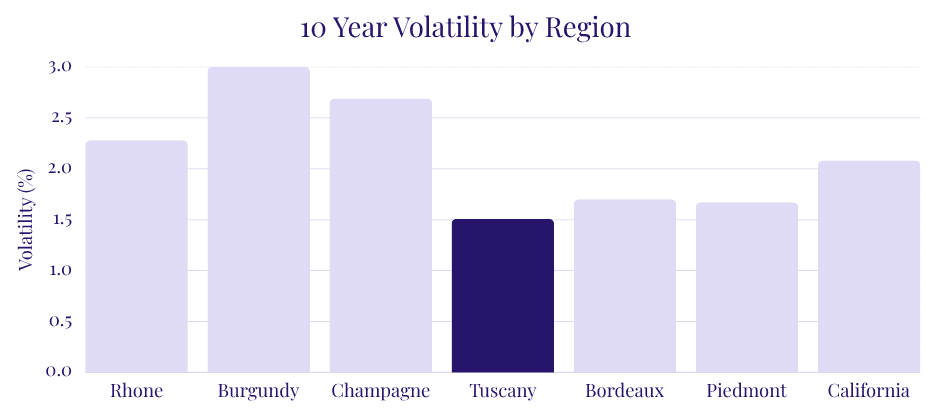
Crucially, top-tier Tuscan wines bucked the more severe downward trends seen in other regions. As the market entered 2026, indicators pointed toward a sharp recovery. The recovery solidified dramatically into mid-2026: the WineFi Trade Price Index surged 4.4% in the second quarter alone, marking the largest quarterly transaction price gain since early 2022. Furthermore, mature Tuscan vintages led all global peers over the past 12 months with an outstanding 8.81% return, significantly outperforming newer releases. This illustrates the asymmetric risk profile of blue-chip Tuscan wines; they participate strongly during periods of market expansion and display notable resilience during broader corrections.
What returns can you expect from leading Tuscan producers?
Market averages often conceal the wide dispersion of returns generated by individual wines. In fine wine investment, the specific asset selected and the entry price determine the outcome. When plotting leading Super Tuscans against traditional peers on a liquidity-versus-return basis, they display superior 10-year annualized CAGRs over Bordeaux First Growths and edge out top Napa Cabernets on both liquidity and returns.
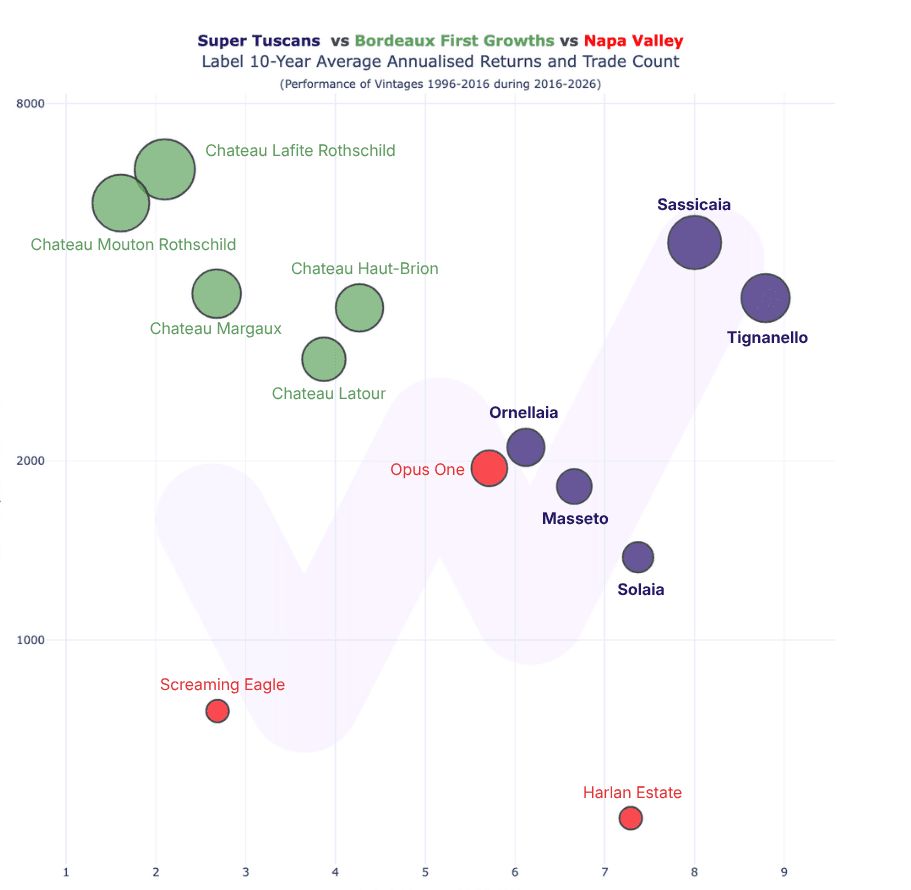
Sassicaia serves as a prime example of sustained value creation. As the original Super Tuscan, it commands massive global demand, achieving an elite 10-year CAGR profile alongside immense secondary market trade volume. Tignanello and Solaia follow closely, with Tignanello holding the highest 10-year annualised return profile among the top five Super Tuscans. Masseto, a highly exclusive Merlot-based wine, and Ornellaia consistently command premium pricing and solid long-term capital appreciation.
Beyond the primary five Super Tuscans, exceptional returns are found in elite Brunellos and independent gems:
Montevertine, Le Pergole Torte: This cult Toscana IGT selection from Radda in Chianti has tripled in price over the last decade, delivering a stellar 10-year annualized CAGR of roughly 11%. It matches its Bolgheri peers on critical scores (~95 points aggregate) while trading at a relative value discount.
Il Marroneto, Madonna delle Grazie: A highly traditional Brunello di Montalcino DOCG that has similarly appreciated at an 11% annualized CAGR over the past decade. Backed by a 96-point aggregate score (with flagship vintages hitting 98–100 points), its small production volume drives an intense scarcity premium.
What is the optimal holding period for Tuscan wines?
Fine wine does not behave like a traded financial equity where prices update continuously. Value is realised episodically over time, making fine wine a medium to long-term investment asset. The most critical factor in maximising returns is understanding a wine's lifecycle and targeting the specific phase where appreciation accelerates.
For Tuscan red wines, market data indicates that the optimal entry window occurs at approximately four years of age. Purchasing wine at release can sometimes mean holding an asset while its price remains stagnant as the initial market supply is absorbed. By entering at the four-year mark, investors bypass this initial sluggishness and acquire the asset just as secondary market demand begins to mature.
The recommended exit window for these Tuscan investments is 22 years of age or older. As wines improve with age and approach their peak drinking windows, consumption steadily reduces the total global inventory. This creates a powerful supply and demand imbalance. The structural scarcity intensifies, which historically supports higher pricing and clearer price discovery. Maintaining a holding period that bridges this 4-to-22-year gap reduces the probability of loss and minimises the transactional friction that destroys value in short-term trading.
How to identify investment-grade Tuscan wine?
Identifying an investment-grade Tuscan wine requires looking past critical scores and focusing strictly on market mechanics. A wine only qualifies as an investment if it exhibits five specific characteristics that guarantee future tradeability.
First, the wine must possess a highly active secondary market. It must trade regularly with deep buyer pools. Without secondary market liquidity, an investor cannot reliably exit their position without making excessive price concessions.
Second, the wine requires recognised provenance and classification. In Tuscany, this means the producer's brand holds enough weight to assure international buyers of the wine's pedigree and quality standards, regardless of traditional DOC constraints.
Third, there must be liquidity at scale. Top Super Tuscans are produced in sufficient quantities to ensure continuous global trading, yet remain scarce enough to drive long-term price appreciation.
Fourth, the wine must demonstrate a proven track record of demand. Demand for investment-grade Tuscan wine persists across decades and economic cycles, driven by structural consumption rather than fleeting trends.
Finally, the supply must be strictly limited and predictable. Production is capped by the physical size of the estate vineyards, ensuring that no new supply of a specific vintage can ever be created.
What are the tax implications of investing in Tuscan wine in the UK?
For UK taxpayers, the regulatory treatment of fine wine provides a highly favorable environment for capital allocation, as explored deeply in our UK wine investment tax guide. The specific characteristics of fine wine often exempt it from standard capital gains liabilities.
HM Revenue and Customs generally classifies fine wine with a predictable drinking life of under 50 years as a "wasting asset". Because the asset is deemed to have a finite useful lifespan, any profits realized from its disposal are typically exempt from Capital Gains Tax. This wasting asset exemption covers the vast majority of investment-grade Tuscan red wines, including all major Super Tuscans and premium Brunello selections.
This tax efficiency allows investors to retain a larger portion of their total returns compared to investments in equities or property, where capital gains are heavily taxed. It is vital to note that certain wines with exceptionally long ageing potential, such as fortified wines or specific dessert wines, may fall outside this definition and trigger tax liabilities. Maintaining a portfolio concentrated on standard Tuscan reds ensures adherence to the wasting asset criteria.
Why is professional bonded storage critical for Tuscan wine?
Fine wine produces absolutely no yield or dividend. The entirety of an investor's return depends on selling the physical bottles at a premium in the future. Therefore, the preservation of the asset's condition and its documented history are the most critical components of the investment process.
The importance of wine storage cannot be overstated: investment-grade Tuscan wine must be stored "in bond" within a government-approved bonded warehouse. These specialized facilities maintain exact industry standards for temperature, humidity, light exposure, and vibration control, ensuring the wine matures flawlessly.
More importantly, bonded storage guarantees an unbroken chain of provenance. Future buyers require absolute certainty regarding a wine's storage history. If a case of Sassicaia is removed from bond and stored in a private residence, its condition can no longer be independently verified. The wine instantly loses its investment-grade status, suffers a massive reduction in liquidity, and will only sell at a severe discount.
Storing wine in bond also defers taxation. While the wine remains in the bonded warehouse, VAT and excise duty are completely suspended. These taxes are only levied if the investor chooses to take physical delivery of the wine, preserving capital efficiency throughout the holding period. Furthermore, reputable storage providers ensure that investor assets are held in segregated accounts, protecting the wine from counterparty risk.
How Tuscan wine connects to your portfolio
An allocation to Tuscan fine wine serves as a powerful diversification tool within a broader investment strategy. Fine wine indices have historically exhibited low correlation with mainstream financial markets, moving independently of interest rate cycles or corporate earnings.
By adding Super Tuscans to a portfolio, investors gain exposure to a tangible, supply-constrained asset that benefits from global wealth expansion and steady consumption. However, success requires stringent discipline regarding entry prices, asset selection, and holding periods. To understand how WineFi applies quantitative modeling to identify undervalued Tuscan assets, review our 2026 Fine Wine Investment Guide or explore our current portfolio options.
Frequently asked questions
What is the best Tuscan wine for investment?
The most reliable Tuscan investments are the elite Super Tuscans, primarily Sassicaia, Tignanello, Solaia, Ornellaia, and Masseto. These specific producers offer the necessary combination of global brand recognition, deep secondary market liquidity, and consistent critical acclaim required for sustained capital appreciation.
How long should I hold a Tuscan wine investment?
Fine wine is a medium to long-term asset. Market data indicates that acquiring Tuscan red wines at approximately four years of age and holding them until they reach 22 years or older optimizes returns, as this captures the phase where diminishing supply drives the strongest price appreciation.
Do I pay Capital Gains Tax on Tuscan wine in the UK?
For the vast majority of UK investors, profits from Tuscan wine are exempt from Capital Gains Tax. HMRC classifies wines with a predictable drinking lifespan of less than 50 years as wasting assets, shielding them from standard capital gains liabilities upon disposal.
What makes a Super Tuscan different from other Italian wines?
Super Tuscans emerged when innovative producers rejected strict traditional regulations to blend international grape varieties like Cabernet Sauvignon with native Sangiovese. This rebellion produced wines of extraordinary quality that rapidly secured international demand and established robust secondary trading markets.
Is Tuscan wine a safe investment?
While fine wine offers low correlation to equities, it carries inherent risks, including market fluctuations and liquidity constraints. Investors can mitigate these risks by focusing exclusively on highly liquid blue-chip Tuscan producers, enforcing strict price discipline, and ensuring all assets are held in professional bonded storage.
Can I store investment wine at home?
Storing investment-grade wine at home irrevocably destroys its financial value. Secondary market buyers demand verifiable proof of perfect storage conditions. Removing wine from a bonded warehouse breaks its chain of provenance, rendering the asset illiquid and forcing significant price discounts upon resale.
How does Tuscan wine perform during economic downturns?
Fine wine generally exhibits asymmetric risk characteristics, often recovering faster than traditional equities during market stress. During the recent market correction leading into 2026, top-end Tuscan wines demonstrated notable resilience, bucking broader downward trends and returning to positive growth early in the year.
This article is provided for general information and is not personal tax or investment advice. Capital is at risk. Wine values can go down as well as up, and investments may not perform as expected. Returns may vary. You should not invest more than you can afford to lose. WineFi is not authorised by the Financial Conduct Authority. Investments are not regulated and you will have no access to the Financial Services Compensation Scheme (FSCS) or the Financial Ombudsman Service (FOS). Past performance and forecasts are not reliable indicators of future results. Investments are illiquid. Tax treatment depends on individual circumstances and may change. You are advised to obtain appropriate tax or investment advice where necessary. WineFi is a trading name of WineFi Management Limited.




Capital is at risk. Wine values can go down as well as up, and investments may not perform as expected. Returns may vary. You should not invest more than you can afford to lose. WineFi is not authorised by the Financial Conduct Authority. Investments are not regulated and you will have no access to the Financial Services Compensation Scheme (FSCS) or the Financial Ombudsman Service (FOS). Past performance and forecasts are not reliable indicators of future results and should not be relied on. Forecasts are based on WineFi’s own internal calculations and opinions and may change. Investments are illiquid. Once invested, you are committed for the full term. Tax treatment depends on individual circumstances and may change.
You are advised to obtain appropriate tax or investment advice where necessary.
WineFi is a trading name of WineFi Management Limited. Registered in England and Wales with registration number: 14864655 and whose registered office is at 5th Floor, 167-169 Great Portland Street, London, United Kingdom, W1W 5PF.