


TL;DR
The Sharpe Ratio and Sortino Ratio are ways of measuring whether an investment made good returns without taking too much risk. The Sharpe Ratio looks at all the ups and downs in value and asks, “Was the return worth the bumpy ride?” A higher number usually means the investment performed more efficiently. The Sortino Ratio is similar, but only cares about the bad downsides, not the good upside jumps. In simple terms, Sharpe measures overall smoothness, while Sortino focuses more on avoiding losses. Over a 10-year period, fine wine has historically delivered a Sortino ratio of 2.57, outperforming the S&P 500 at 1.47 and the FTSE 100 at 0.96. This metric is critical for wine investors because fine wine experiences asymmetric risk. It tends to hold value during market stress, meaning investors are compensated efficiently for the specific downside risk they take on.
What exactly is the Sortino ratio?
The Sortino ratio is a modification of the Sharpe ratio. Both metrics evaluate the return of an investment relativez to the risk taken to achieve it. The core difference lies entirely in how they define risk. The Sharpe ratio penalises all volatility. If an asset suddenly spikes in value, the Sharpe ratio treats that upward price movement as risk. The Sortino ratio isolates negative volatility. It only penalises an asset when its price drops below a minimum acceptable return.
For investors who want to understand the mathematics, the formula is:
Where R is the actual or expected return, T is the target or minimum acceptable return, and DR is the downside deviation.
This distinction matters heavily for alternative assets. Investors do not typically worry about upside volatility. Downside volatility is what causes portfolio stress and wealth destruction. By focusing exclusively on downside deviation, the Sortino ratio provides a much clearer picture of the actual risk an investor is taking to achieve a stated return.
Why does the Sortino ratio matter for fine wine?
Fine wine does not trade continuously on a public exchange. Prices are discovered episodically through discrete transactions rather than constant marking-to-market. Because of this structural difference, fine wine does not exhibit the same daily price fluctuations as public equities.
When evaluating fine wine, measuring total volatility misses the point. The primary concern for investors is drawdown risk during periods of market stress. Fine wine has historically demonstrated asymmetric downside risk. It tends to experience limited drawdowns and relatively fast recoveries compared to traditional equities.
The Sortino ratio captures this behaviour accurately. It shows how efficiently fine wine compensates investors for the actual downside risk they experience, rather than penalising the asset for its lack of daily price updates.
How has fine wine performed on a risk-adjusted basis?
When measured by the Sortino ratio, fine wine has historically offered attractive risk-adjusted returns versus traditional asset classes. A higher value indicates that an asset has historically generated more return for each unit of downside risk taken.
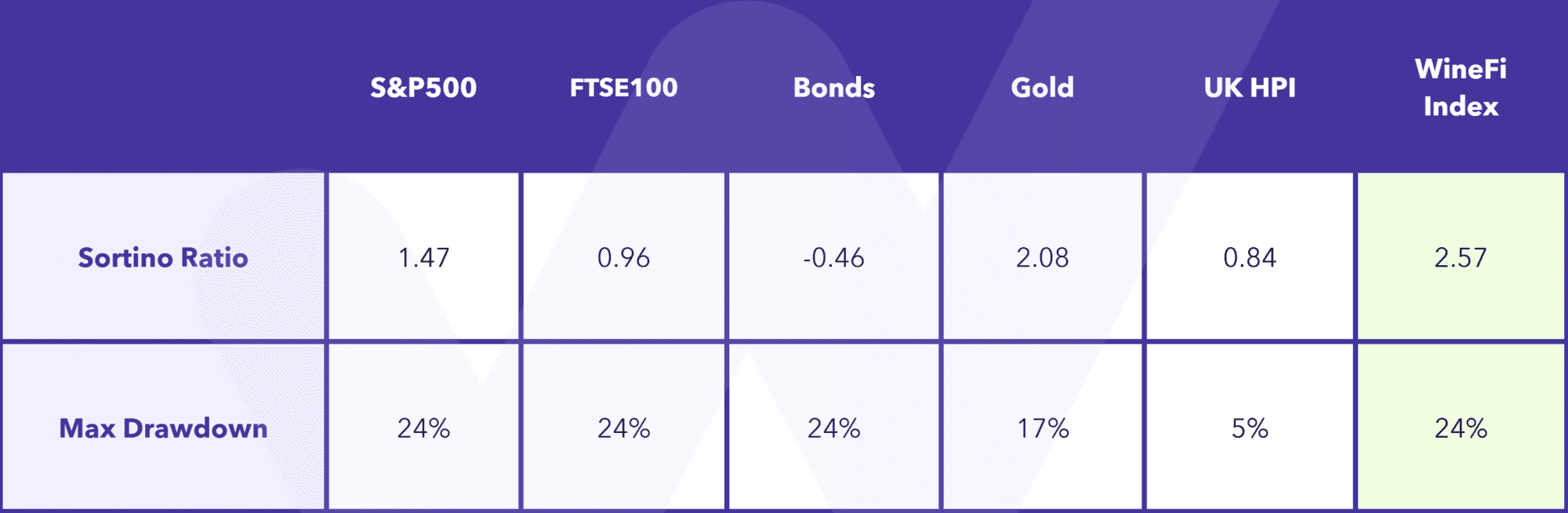
Over a recent 10-year period, the asset class comparison shows a clear divergence:
WineFi Index | 2.57 |
|---|---|
Gold | 2.08 |
S&P 500 | 1.47 |
FTSE 100 | 0.96 |
UK HPI | 0.84 |
Bonds | -0.46 |
These figures show that price adjustments in fine wine have historically tended to occur more gradually and episodically. The asset class has achieved its returns smoothly, exposing investors to fewer sudden downside shocks than traditional equities or bonds over the same timeframe.
What asymmetric risk means for a portfolio
Asymmetric risk means the potential for upside is greater than the probable downside. Even in periods of severe market stress, fine wine has shown limited drawdowns. During the early stages of the Covid-19 pandemic, while traditional equities fell, fine wine experienced a price boom.
This does not imply fine wine is immune to drawdowns. It can and does experience periods of declining liquidity and softening prices. The key takeaway is that its pattern of risk is structurally different. It is far less dominated by sudden, severe drops.
This makes fine wine a highly effective complementary allocation. It introduces a return stream driven by different market forces. It helps balance portfolios that are heavily exposed to the daily volatility of public markets by introducing stability during equity corrections.
How risk-adjusted returns connect to your portfolio
If you are looking to start investing in fine wine, understanding downside risk is the first step in building a resilient portfolio. While the Sortino ratio proves the historical efficiency of fine wine as an asset class, capturing those returns requires strict discipline. It demands rigorous selection criteria, clear provenance checks, and acquiring wines at the correct entry price.
Our quantitative models incorporate millions of data points to identify investment-grade wines that offer the strongest potential returns. We focus on assets that have historically defended capital well during downturns and captured upside during market expansions.
To explore our methodology further, read the 2026 Fine Wine Investment Guide or sign up to view our current investment opportunities on the platform.
Frequently asked questions
What is a good Sortino ratio for fine wine?
A Sortino ratio above 2.0 is generally considered excellent across all asset classes. Over a recent 10-year period, the WineFi Index achieved a Sortino ratio of 2.57. This indicates that the portfolio generated highly efficient returns relative to the downside risk experienced.
How does the Sortino ratio differ from the Sharpe ratio?
Both ratios measure risk-adjusted returns. The Sharpe ratio penalises all volatility, meaning upward price spikes actively hurt the score. The Sortino ratio isolates negative volatility, penalising an asset only when its price drops. This makes it far more practical for evaluating alternative assets.
Does a high Sortino ratio mean fine wine has zero risk?
No investment is completely immune to risk. A high Sortino ratio simply indicates that fine wine has historically experienced fewer severe downside drawdowns than other mainstream assets. It still carries market risk, liquidity risk, and provenance risk that must be managed carefully through structured buying and bonded storage.
Why is fine wine volatility lower than stocks?
Fine wine prices are driven by structural scarcity and steady consumption. Supply decreases permanently as bottles are consumed. Furthermore, prices are formed through discrete physical transactions rather than constant screen-based algorithmic trading. This prevents the rapid panic selling often seen in equities.
How often should I check my portfolio's Sortino ratio?
Fine wine is a medium-to-long-term asset. Returns generally build over a four to seven year holding period. Evaluating risk metrics daily or monthly is counterproductive. Investors should review risk-adjusted performance annually to ensure their allocation aligns with their broader wealth strategy.
Can the Sortino ratio predict future returns?
No, the Sortino ratio is a backward-looking metric that evaluates historical risk-adjusted performance. While it helps investors understand how an asset has behaved during past market stress, past performance is not a reliable indicator of future results.
Why do traditional volatility metrics fail for fine wine?
Traditional metrics like the Sharpe ratio penalise all price movement, including upward spikes. Because fine wine does not trade continuously on an exchange, these metrics often obscure the true downside risk. The Sortino ratio isolates negative volatility, making it a more accurate tool for evaluating alternative assets.
This article is provided for general information and is not personal tax or investment advice. Capital is at risk. Wine values can go down as well as up, and investments may not perform as expected. Returns may vary. You should not invest more than you can afford to lose. WineFi is not authorised by the Financial Conduct Authority. Investments are not regulated and you will have no access to the Financial Services Compensation Scheme (FSCS) or the Financial Ombudsman Service (FOS). Past performance and forecasts are not reliable indicators of future results. Investments are illiquid. Tax treatment depends on individual circumstances and may change. You are advised to obtain appropriate tax or investment advice where necessary. WineFi is a trading name of WineFi Management Limited.




Capital is at risk. Wine values can go down as well as up, and investments may not perform as expected. Returns may vary. You should not invest more than you can afford to lose. WineFi is not authorised by the Financial Conduct Authority. Investments are not regulated and you will have no access to the Financial Services Compensation Scheme (FSCS) or the Financial Ombudsman Service (FOS). Past performance and forecasts are not reliable indicators of future results and should not be relied on. Forecasts are based on WineFi’s own internal calculations and opinions and may change. Investments are illiquid. Once invested, you are committed for the full term. Tax treatment depends on individual circumstances and may change.
You are advised to obtain appropriate tax or investment advice where necessary.
WineFi is a trading name of WineFi Management Limited. Registered in England and Wales with registration number: 14864655 and whose registered office is at 5th Floor, 167-169 Great Portland Street, London, United Kingdom, W1W 5PF.